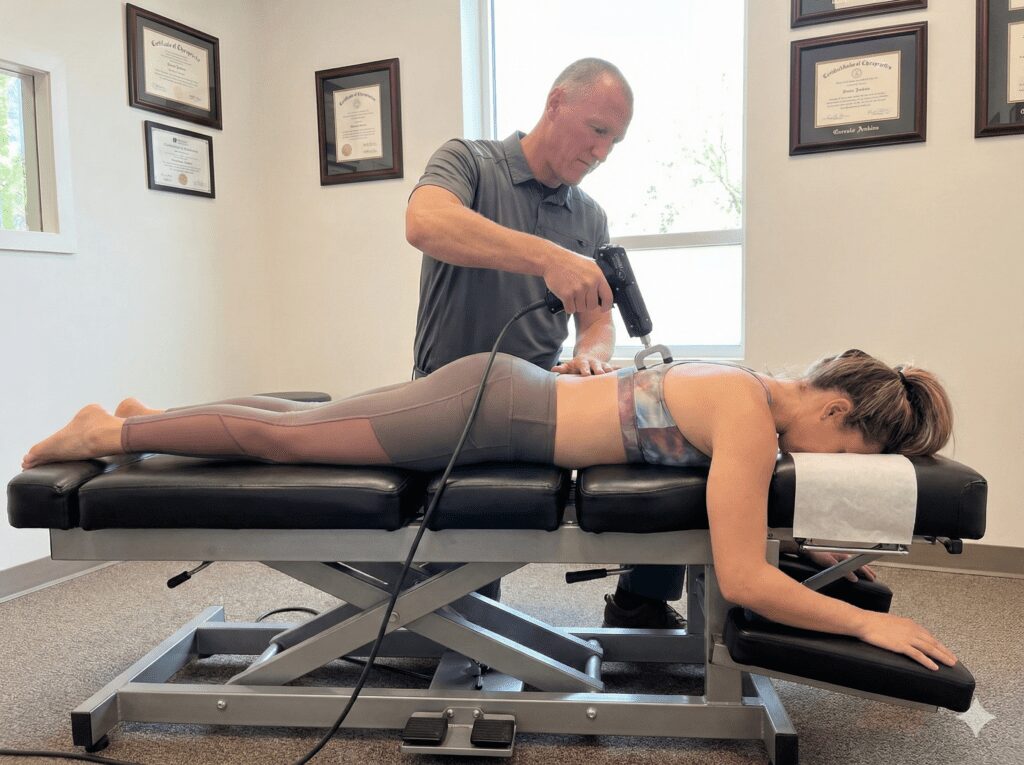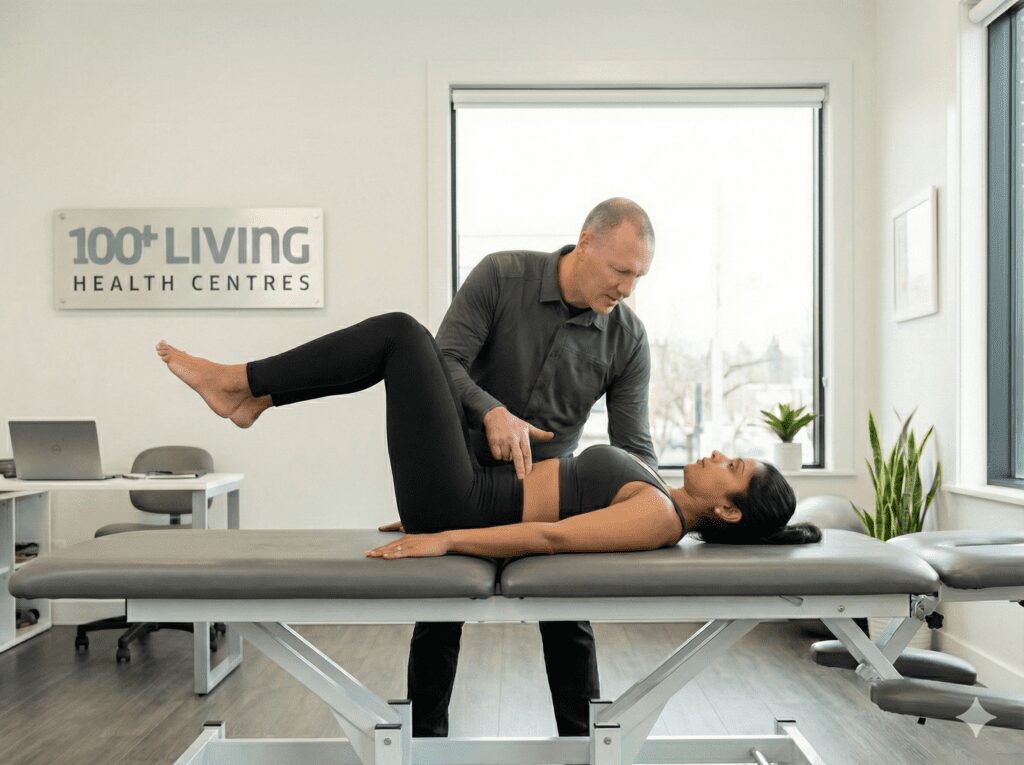
Why This Conversation Still Matters in 2026
Many years ago, a powerful idea from the book Ready to Run helped shift how athletes, clinicians, and everyday people think about pain and performance. The core message still holds true today: the human body adapts to the positions it lives in most. When those positions are unhealthy, movement suffers.
In modern life, most people are not limited by a lack of motivation or effort. They are limited by posture, environment, and accumulated stress on the nervous system. From first grade desks to long workdays, from phones to footwear, our bodies slowly adapt to shapes that are no longer supportive of running, training, or even pain‑free daily living.
This is where corrective chiropractic care in Kelowna plays a critical role—not as symptom management, but as structural and neurological restoration.
Born to Move, Conditioned to Sit
– Movement & Posture
“The body adapts to the positions it spends the most time in. If you sit all day, your tissues will organize themselves for sitting — not running, lifting, or long-term performance.”
— Kelly Starrett, DPT, Ready to Run (paraphrased for educational use)
Human beings evolved to move.
Human beings evolved to move. Walking, running, lifting, and climbing shaped the spine, joints, and nervous system. Problems begin when movement is replaced by prolonged sitting.
Research consistently shows that tissues and joints remodel in response to sustained posture. Prolonged sitting has been associated with reduced hip extension, altered muscle length, and changes in spinal mechanics [1]. Over time, these changes affect how force is absorbed and distributed during activity.
When children spend years seated, adults spend decades at desks, and leisure time revolves around screens, the body adapts accordingly. These adaptations are not moral failures or signs of weakness—they are predictable biological responses.
Posture Is Not Cosmetic — It Is Neurological
Posture directly influences the nervous system. The spine houses and protects the spinal cord, and abnormal spinal alignment increases mechanical stress on neural tissues.
Forward head posture, rounded shoulders, and flattened spinal curves have been associated with:
- Increased spinal cord strain
- Altered muscle firing patterns
- Reduced balance and coordination
- Higher injury risk during sport and training [2]
In chiropractic and physical medicine literature, spinal alignment is increasingly recognized as a key determinant of long‑term musculoskeletal and neurological health [3].
This is why modern chiropractic in Kelowna must go beyond short‑term pain relief.
The Athlete’s Trap: Training Through Dysfunction
One of the most common patterns seen in high‑level athletes is the belief that pain is simply part of progress. Many elite performers train through discomfort, assuming strength and conditioning alone will solve the problem.
This approach may work temporarily. However, when faulty movement patterns and poor spinal mechanics persist, the nervous system eventually intervenes. Pain, reduced performance, and recurring injuries are often the result.
As spine researcher Dr. Stuart McGill has shown, repeated loading on compromised structures leads to cumulative damage rather than resilience [4]. The body keeps score.
This Is Not Just an Athlete’s Problem
The same principles apply to everyone:
- The parent fitting workouts between responsibilities
- The office worker training for a half‑marathon
- The teenager pursuing competitive sport
- The adult simply trying to stay active without pain
Whether you are a recreational runner or a drafted WHL athlete, posture and spinal mechanics matter.
This is why many people seek a Kelowna chiropractor not only when pain appears, but when they want to stay active for decades.
From Symptom Relief to Structural Correction
Traditional care models often focus on managing pain once it appears. While this can be helpful short term, it does not address why the issue developed.
Corrective chiropractic care focuses on:
- Identifying abnormal posture and spinal alignment
- Measuring spinal curves objectively
- Reducing mechanical stress on joints and nerves
- Supporting long‑term neurological function
This approach aligns with evidence from Chiropractic BioPhysics® (CBP®), which emphasizes that structure governs function [5].
Chiropractic BioPhysics®: A Posture‑First Model
CBP is a posture‑based, evidence‑informed system of spinal rehabilitation. It is built on decades of peer‑reviewed research examining spinal curves, biomechanics, and neurological outcomes.
CBP‑based chiropractic care in Kelowna commonly includes:
- Detailed posture assessment
- Spinal imaging when clinically appropriate
- Targeted corrective exercises
- Spinal traction to restore normal curves
- Adjustments that support structural goals
Clinical trials show that improving spinal alignment leads to better long‑term outcomes than symptom‑based care alone [6].
Why Stretching Alone Is Not Enough
Mobility work has value, but it is often misunderstood. Stretching tissues that are already structurally overloaded may temporarily reduce tension, but it does not correct the underlying cause.
As movement expert Gray Cook has emphasized, mobility without stability and alignment often leads to recurring dysfunction [7].
Corrective chiropractic care addresses the source of the restriction, not just the sensation of tightness.
Running, Resilience, and Spinal Curves
Efficient running requires:
- Adequate hip extension
- Stable lumbar lordosis
- Balanced cervical posture
- Responsive neurological control
Loss of spinal curves alters shock absorption and increases strain on discs and joints [8]. Over time, this contributes to chronic injuries that sideline even dedicated athletes.
A Kelowna chiropractic clinic focused on posture correction helps restore these mechanical foundations.
Modern Life Requires Modern Care
The environments we live in have changed dramatically. Chairs, cars, phones, and screens are not neutral. They shape the spine every day.
Corrective chiropractic care exists to reverse these patterns—not by blaming lifestyle, but by responding intelligently to it.
This is especially important for those who want to:
- Run without recurring injuries
- Train hard while protecting joints
- Maintain nerve health with age
- Stay competitive into later decades of life
Longevity, Performance, and the Nervous System
Longevity is not about avoiding activity. It is about preserving the systems that make activity possible.
Research in physical medicine shows that spinal alignment influences balance, coordination, and neural efficiency—all key factors in aging well [9].
This is why many people pursuing long‑term health choose chiropractic care in Kelowna that emphasizes correction, not just comfort.
What Corrective Chiropractic Looks Like in Practice
A corrective approach typically includes:
- Objective baseline measurements
- Individualized care plans
- Progress tracking over time
- Re‑assessment to confirm structural change
This process is designed to support both performance and longevity.
You Don’t Have to Stop — You Have to Correct
Pain is often a message, not a mandate to quit. When addressed early and intelligently, many people can return to training stronger and more resilient.
Whether your goal is to run faster, lift longer, or simply enjoy daily movement, posture and spinal alignment are foundational.
Corrective chiropractic care helps bring the body back toward balance so movement can be enjoyed—not feared.
Frequently Asked Questions About Posture, Running, and Chiropractic Care
Can chiropractic care help runners avoid injury?
Evidence suggests that improving spinal alignment and movement mechanics may reduce abnormal loading on joints and tissues. Corrective chiropractic care focuses on posture and spinal curves, which are key contributors to running efficiency and resilience [8].
Is posture really that important for nerve and joint health?
Yes. Research shows that spinal posture influences nerve tension, muscle activation, balance, and coordination. Poor alignment can increase mechanical stress on the nervous system over time [2][3].
Why do injuries keep returning even when I stretch and strengthen?
Stretching and strengthening are important, but they do not change spinal structure on their own. If underlying postural patterns remain unchanged, the same tissues continue to experience abnormal stress [7].
How is corrective chiropractic different from traditional chiropractic?
Corrective chiropractic focuses on measurable structural change rather than short-term symptom relief. This often includes posture analysis, spinal traction, and re-evaluation to confirm progress [5][6].
Is corrective chiropractic only for athletes?
No. While athletes often seek care to improve performance, many people pursue corrective chiropractic to stay active, reduce recurring pain, and support long-term neurological health.
Final Thoughts
We may be born to move, but modern life reshapes us in ways that challenge that birthright. The solution is not less activity—it is better structure.
By addressing posture, spinal curves, and neurological function, corrective chiropractic care supports a future where training, movement, and vitality extend well into later life.
If you are looking for a chiropractor in Kelowna who focuses on long‑term function, posture correction, and active longevity, this approach may be worth exploring.
Schedule a free consultation to learn how corrective chiropractic care may support your training, performance, and long‑term health.
Take the Next Step
Don’t settle for temporary relief. Get care that helps correct the cause of your condition.
Step 1:
Start with a free 10-minute phone consult to discuss your symptoms and see if our approach is right for you.
Step 2:
Book your first comprehensive exam and consultation and get started.
References
- Prolonged sitting and physical inactivity are associated with limited hip extension. https://pubmed.ncbi.nlm.nih.gov/33188982/
- Forward head posture and spinal cord strain. https://pubmed.ncbi.nlm.nih.gov/19557833/
- Spinal alignment and musculoskeletal outcomes. https://pubmed.ncbi.nlm.nih.gov/25729058/
- McGill SM. Low back disorders: evidence-based prevention and rehabilitation. https://www.backfitpro.com/
- Harrison DE et al. Chiropractic BioPhysics® principles and spinal correction. https://pubmed.ncbi.nlm.nih.gov/20046632/
- Structural rehabilitation vs symptom-based care outcomes. https://pubmed.ncbi.nlm.nih.gov/25629270/
- Cook G. Movement: Functional Movement Systems. https://www.functionalmovement.com/
- Lumbar lordosis and load distribution. https://pubmed.ncbi.nlm.nih.gov/15507727/
- Spinal posture, balance, and aging. https://pubmed.ncbi.nlm.nih.gov/22146295/