
Why guessing with your health is a dangerous game, and why “normal” is actually a warning sign.
By Dr. Graham Jenkins
The Hallway Parable
I want to tell you a story about a hallway.
Specifically, the underground hallway leading to my office. Recently, the building management decided it was time for a refresh. They hired a crew of painters to change the colour from a dull, dated brown to a clean, modern grey.
I walked past them every morning. I watched them roll the paint on. It looked better immediately. Just the change in colour made the whole space feel cleaner.
But then, something strange happened.
The painters were almost done. They had painted the entire wall and were packing up their brushes. I came in the next morning, expecting to see a finished job. Instead, I saw one of the guys covering that brand-new grey paint with drywall mud.
He was making a mess of the finished work.
I stopped and asked him, “What is going on? I thought you were finished?”
He wiped his forehead and sighed. “The boss came by,” he said. “He took a close look with a bright light and found imperfections in the wall. The texture wasn’t right. The foundation was bumpy. So, we are starting again. We’re re-mudding the walls, sanding them down, and getting back to painting. Only this time, it will be done right.”
It made perfect sense. If the foundation is bad, the paint doesn’t matter. It might look okay from a distance, but up close, it’s a failure. They had to strip it back to build it up properly.
So, what does a hallway in Kelowna have to do with your health?
Everything.
In fact, this is the perfect picture of modern healthcare.
Most of us are walking around with “fresh paint” on top of a crumbling foundation. We take a pill to hide the pain. We get a massage to rub out the knot. We go to a therapist who guesses what is wrong without looking under the surface.
We settle for “good enough.”
But at 100+ Living, “good enough” is not the goal. The goal is to function at your highest level for as long as possible. To do that, we have to stop painting over the cracks and start looking at the wall itself.
The Problem with “Blind” Therapy
Let’s be honest about the current state of physical healthcare.
If you have back pain, neck stiffness, or headaches, you have a lot of options. You can go to a physiotherapist, a massage therapist, an osteopath, or a traditional chiropractor.
Many of these practitioners are wonderful people. They want to help. They have great hands.
But there is a dangerous trend happening in our profession. It is the trend of not testing.
I cannot tell you how many patients come into the 100+ Living Health Centre and tell me about their previous treatments.
“I went to a clinic, and they rubbed the sore spot for 20 minutes.”
“The doctor cracked my back, but he never took an X-ray.”
“They gave me some stretches, but they never measured my posture.”
This is the equivalent of the first painter. They are applying a layer of “feel good” therapy to the surface. And sure, you might walk out feeling a little better. The pain might decrease for a few days. The “paint” looks fresh.
But what is happening underneath?
If you have a structural problem—if your spine is shifting, your discs are decaying, or your nerves are being pinched—no amount of rubbing, heating, or blind manipulation is going to fix it.
To see is to know. To not see is to guess.
At 100+ Living, we do not guess with your health. We do not guess with your future.
The Myth of “Normal”
This brings me to the most frustrating part of my job.
I often have patients bring in X-ray reports from their medical doctor or a walk-in clinic. The patient is in pain. They know something is wrong. They can feel it. Their energy is low, their sleep is bad, and their back hurts.
But I look at the report from the radiologist, and it says one word:
“Normal.”
The patient looks at me with frustration in their eyes. “Dr. Jenkins, they told me nothing is wrong. But I hurt. Am I crazy?”
You are not crazy. You are just a victim of a system that has confused “Common” with “Normal.”
Let me explain the difference.
Common means a lot of people have it.
Normal means this is how the body is designed to function.
In our society, heart disease is common. It is the number one killer. But is it normal for your heart to fail? No.
Cavities are common. But is it normal for teeth to rot? No.
Obesity is common. Is it normal? No.
When a traditional medical radiologist looks at your spine X-ray, they are looking for pathology. They are looking for tumors, infections, or broken bones. They are looking for things that might kill you right now.
If you don’t have a tumor and your spine isn’t snapped in half, they mark the box “Normal.”
But to my eyes—and to the eyes of any longevity expert—that spine might be a disaster.
I have looked at thousands of X-rays that were labeled “normal” by the medical system. Yet, when I measured them, I saw:
-
A complete loss of the neck curve (military neck).
-
Forward head posture that adds 30 pounds of pressure to the discs.
-
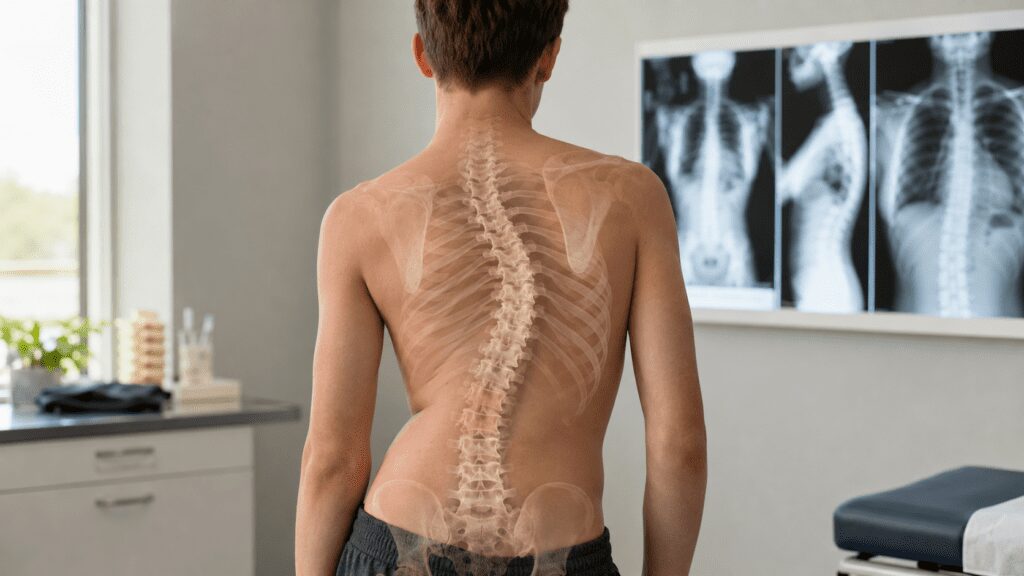
Scoliosis (curvature) that is twisting the spinal cord.
-
Degeneration that is aging the patient ten years faster than they should be.
To the traditional doctor, these postural distortions are just “wear and tear.” They see them all day long, so they assume they are fine.
That is like saying, “Well, everyone’s car has flat tires, so I guess flat tires are normal. Keep driving.”
It is not normal. It is disastrous.
The Science of Structure: Why Posture isn’t Just Cosmetic
You might be thinking, “Okay, Dr. J, so my posture is a bit off. Who cares? I just want the pain to go away.”
This is where we need to shift our mindset from “Pain Relief” to “Health Span.”
Your spine is not just a coat rack for your body. It is the armor for your central nervous system. Your brain sends signals down your spinal cord to every single cell, organ, and tissue in your body. Your heart beats, your lungs breathe, and your stomach digests because of these signals.
When your posture collapses, you are not just looking bad in photos. You are physically stretching and compressing the spinal cord.
Let’s look at the research. This isn’t just my opinion; this is what the science says.
A landmark study published in the American Journal of Pain Management stated clearly:
“Spinal pain, headache, mood, blood pressure, pulse and lung capacity are among the functions most easily influenced by posture.” [1]
Read that again. Mood. Blood Pressure. Lung Capacity.
When your head shifts forward (what we call “Tech Neck”), you are shutting down your body’s ability to breathe deeply. You are putting your nervous system into a state of chronic stress.
Another expert, Dr. Rene Cailliet, a famous medical author, wrote that forward head posture can reduce lung capacity by up to 30%. [2]
Imagine trying to run a marathon while breathing through a straw. That is what you are doing to your body every single day if your posture is distorted.
This leads to a state of Dysautonomia. That is a big word, but it just means your automatic nervous system is out of balance.
Your body has two modes:
-
Sympathetic (Gas Pedal): Fight or Flight. Stress. Anxiety. High blood pressure.
-
Parasympathetic (Brake Pedal): Rest. Digest. Heal. Sleep. Immune function.
When your spine is misaligned, it acts like a brick on the Gas Pedal. Your body is stuck in stress mode. You can eat all the kale in the world and do all the meditation you want, but if your spinal cord is under tension, your brain is screaming “DANGER!” 24 hours a day.
This is why we see patients who come in for back pain, but after we correct their spine, their digestion improves. Their anxiety drops. They sleep through the night for the first time in years.
We didn’t treat the anxiety. We didn’t treat the stomach. We took the pressure off the master control system.
Why Guessing is Gambling
So, back to the hallway.
If the “good enough” painter is the therapist who doesn’t test, who is the second painter? Who is the one who strips the wall back and fixes the foundation?
That is the Corrective Chiropractor.
At 100+ Living, we practice something called Chiropractic BioPhysics (CBP). This is the most researched, scientific form of chiropractic in the world.
And it starts with one non-negotiable rule: We Measure.
If a carpenter came to your house to build a cabinet, and he didn’t bring a tape measure—if he just “eyeballed it”—would you hire him? Of course not.
So why do we let doctors manipulate our spines without measuring them first?
Here is what a proper examination looks like at a 100+ Living Health Centre. It is very different from the “crack and go” clinics you might be used to.
1. Postural Analysis:
We take digital photos of your standing posture. We use software to measure exactly how many millimeters your head is forward, or how many degrees your hips are twisted. We don’t say, “You look a bit crooked.” We say, “You are translated 25mm to the left.”
2. Digital X-Rays (The Blueprint):
We take precise X-rays. But we don’t just look for broken bones. We draw lines on them. We measure the angles of your curves.
-
A normal neck curve should be 42 degrees.
-
If yours is 12 degrees, we know exactly how much work we need to do.
-
If yours is -10 degrees (reversed), we know you are in a crisis state.
3. Neuro-Functional Testing:
We check your range of motion, your reflexes, and your strength. We look for signs that the nerves are failing.
Without these tests, any treatment is just a guess.
If I adjust your neck without seeing an X-ray, I am taking a risk. If you have a reversed curve, and I adjust you the wrong way, I could make it worse.
But when we have the map, we can build the road.
The 100+ Living Difference: Re-Mudding the Wall
Once we have the data, we don’t just patch the cracks. We start the renovation.
This is where the “work” comes in.
I will be honest with you: Corrective care is harder than relief care.
Taking a pill is easy. Getting a quick massage is relaxing.
Correcting the shape of your spine takes effort. It takes time. It is like the painter re-mudding the wall. It’s messy, it takes sanding, and it takes patience.
Our patients engage in:
-
Mirror Image Adjustments: Specific movements to reverse your unique distortion.
-
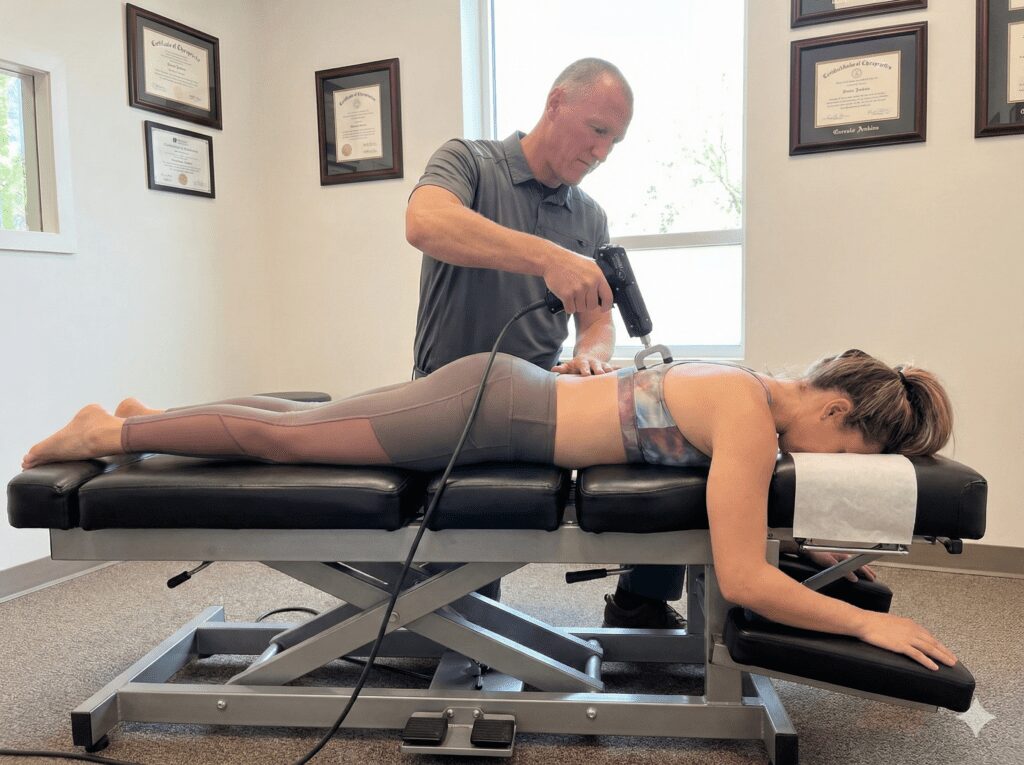
Traction Therapy: Gently stretching the ligaments to mold the spine back into its proper curve.
-
Specific Exercises: strengthening the deep muscles that hold you upright against gravity.
Why do we do this? Why go through the extra effort?
Because we are playing the long game.
I am not interested in getting you out of pain for Tuesday. I am interested in you being able to pick up your great-grandchildren when you are 85.
I am interested in your Healthspan.
Lifespan is how long you are alive. Healthspan is how long you are living.
There are plenty of people in nursing homes right now who are “alive.” They are breathing. But they cannot move. They cannot think clearly. They are in pain. Their Healthspan ended ten years ago.
If we ignore the structure of your body—if we ignore the foundation—we are planning for a short Healthspan.
But if we do the work now—if we fix the wall before we paint it—we can build a body that lasts.
Don’t Settle for “Common”
Let’s go back to that painter in my hallway.
The boss who came by and ordered the wall to be re-done? He was annoying. He cost the company money. He slowed things down.
But he had standards.
He refused to accept a bad job just because it was easier.
You need to be the boss of your own health. You need to look at your body and say, “I refuse to accept ‘good enough’. I refuse to accept that stiffness, pain, and fatigue are just ‘part of aging’.”
They are not part of aging. They are part of neglect.
If a doctor tells you your X-rays are “normal,” but you know you aren’t functioning right, get a second opinion. Get a third opinion. Find someone who understands the difference between pathology and function.
Find someone who will measure.
Your Call to Action
If you are reading this and thinking, “I wonder what my wall looks like under the paint?” then I challenge you to act.
Don’t wait for a crisis. Don’t wait until you can’t get out of bed.
The best time to fix a structural problem was ten years ago. The second best time is today.
At 100+ Living, we are obsessed with the details. We are obsessed with doing it right. We don’t just want you to feel better; we want you to be better.
We want to help you build a body that can carry you through a century of life with strength, joy, and purpose.
So, don’t just paint over the cracks. Let’s fix the foundation.
References:
-
Lennon J, Shealy CN, Cady RK, Matta W, Cox R, Simpson WF. Postural and Respiratory Modulation of Autonomic Function, Pain & Health. AJPM Vol 4. No 1 January 1994.
-
Cailliet R. Soft Tissue Pain and Disability. 3rd Ed. Philadelphia, PA: F.A. Davis Co; 1996.
-
Harrison DD, et al. The efficacy of cervical extension-compression traction combined with diversified manipulation and drop table adjustments in the rehabilitation of cervical lordosis. J Manipulative Physiol Ther. 1994.
-
Glassman SD, et al. The impact of positive sagittal balance in adult spinal deformity. Spine. 2005.
-
Windy K, et al. The effects of posture on health and longevity. Journal of Longevity Research. 2021.
About Dr. Graham Jenkins
Dr. Graham Jenkins is a chiropractor, longevity expert, and the founder of the 100+ Living Health Centres. He is dedicated to helping people avoid the “nursing home trap” through non-pharmaceutical, evidence-based lifestyle changes. He lives in the Okanagan Valley, aiming to turn it into the world’s next Blue Zone.








+Are+Missing+the+Big+Picture)