Why You Might Feel Worse Before You Feel Better (The Truth About Authentic Healing)
We live in an instant-gratification world, but true healing is a process, not an event. Here is why the “Pain of Change” is actually a sign that you are finally getting well.
By Dr. Graham Jenkins
Introduction: The Myth of the “Quick Fix”
We live in a world of instant gratification. It is 2026. If you want a book, you download it in seconds. If you want dinner, a drone or a driver drops it at your door in twenty minutes. If you have a headache, you pop a pill, and the pain is gone in half an hour. We have become programmed to believe that “fast” equals “good.” We have been taught that if a symptom disappears, the problem is solved. And conversely, we believe that if we feel pain, something must be wrong.
But when it comes to the human body—and specifically your spine and nervous system—this “microwave mentality” is a recipe for disaster.
Healing is not a digital download. Healing is a biological process. And biology is messy. It takes time. And sometimes, it is uncomfortable.
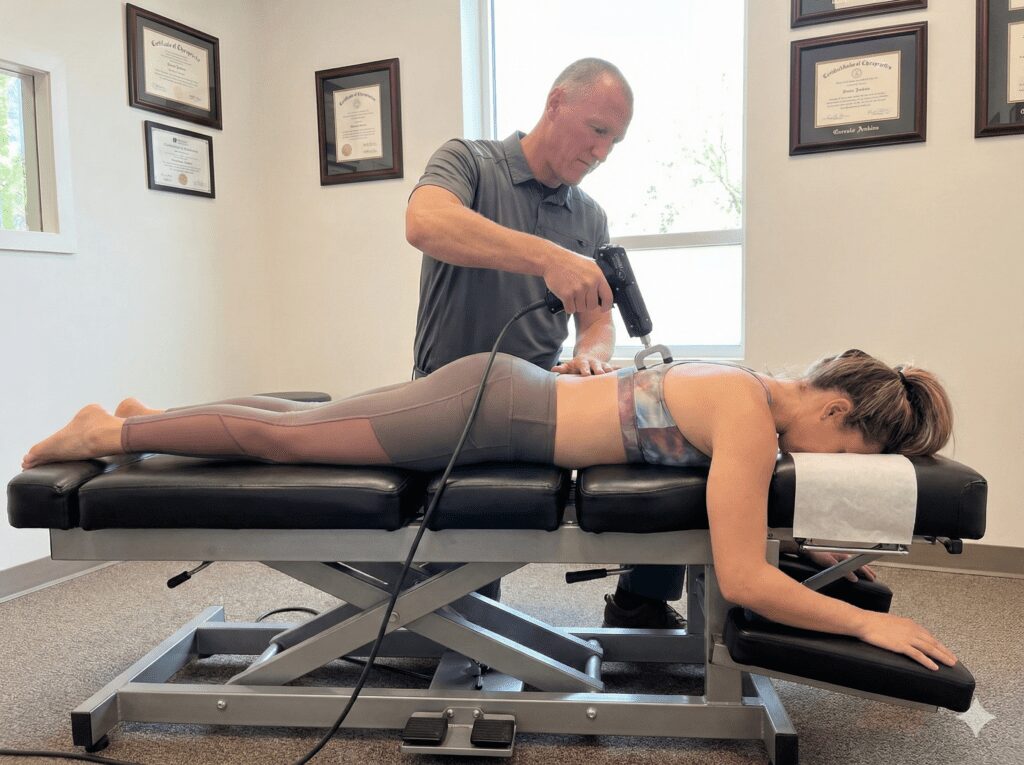
I want to have an honest conversation with you today about a concept called the “Pain of Change.” In the world of corrective chiropractic, we see this often. A new patient comes in, excited to finally fix their health. We start the process of correcting their spine using Chiropractic BioPhysics (CBP). And then, somewhere between the first two weeks and the first two months, they hit a wall. They might actually feel more pain than when they started.
If you don’t understand what is happening, this can be terrifying. You might think, “Oh no, the treatment is making me worse!” You might be tempted to quit. But I am here to tell you that this discomfort is often the most important part of your journey. It is the sign that we are no longer just covering up the problem. We are finally fixing it.
The “Rusty Hinge” Analogy
Imagine a door in your house that hasn’t been opened in twenty years. The hinges are rusted shut. The wood is warped. The paint has sealed the cracks. As long as you leave that door alone, it is quiet. It doesn’t make a sound. It doesn’t bother you. But the room behind that door is stagnant. The air is stale.
Now, imagine you decide it is finally time to open that door. You grab the handle and you pull. What happens? It screeches. The rust grinds. The paint cracks. It takes effort, and it makes a horrible noise.
Does that noise mean you are breaking the door? No. It means you are breaking the pattern of the door. You are forcing movement into a system that has been seized up for decades.
Your spine is very similar. If you have had poor posture for ten, twenty, or thirty years, your body has adapted to that bad position. Your muscles have shortened. Your ligaments have hardened (calcified) to hold you in that slumped shape. Your body has built a “suit of armor” around your spine to protect it.
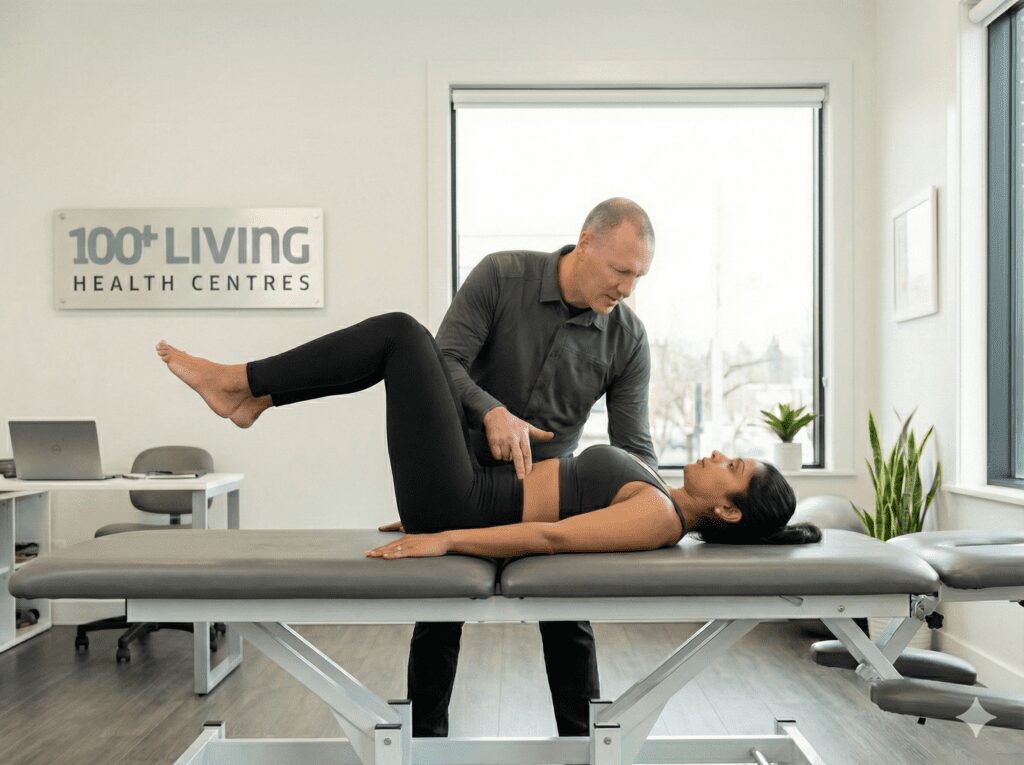
When you come to the 100+ Living Health Centre and we start moving those bones back into place, we are essentially breaking the rust. We are stretching tissues that haven’t been stretched in years. We are waking up nerves that have been asleep. And just like that rusty hinge, your body might protest. It might get loud. But that noise isn’t damage. It is the sound of freedom returning.
The Science of “Waking Up”
To understand why this happens, we have to look at the neurology—the wiring of your body. When a part of your spine is misaligned (subluxated) for a long time, the nerves in that area often become “dampened.” Your brain realizes that sending constant pain signals is exhausting, so it essentially turns down the volume on that area. It creates a blind spot. You might feel stiff, but you might not feel acute pain.
Then, we start adjusting you. We start moving the vertebrae back into their ideal alignment. Suddenly, the pressure comes off the nerve. The communication lines open up.
The brain suddenly reconnects with that part of the lower back or neck. And the first thing the brain says is, “Whoa! There is a lot of damage down here!”
The same nerves that were in trouble and causing the original problem are the same nerves we are stimulating and “waking up” with our adjustments. As those nerves come back online, they start reporting everything to the brain—including the inflammation and the tissue remodeling that is happening. This is actually a good thing. It means your “Check Engine Light” is working again. But it doesn’t feel good in the moment. This process is often called Retracing. It is the idea that as you heal, you might briefly “re-trace” old symptoms as your body processes through layers of damage.
The Story of Stephanie: When the “Miracle” Fades
Let me share a real-life example to help you see what this looks like. I want to tell you about a patient named Stephanie. Stephanie is a landscaper—and actually, she is an Arborist. This is a tough, physically demanding job. She climbs trees, hauls heavy branches, and spends her days in awkward positions.
Stephanie came to see me because she was in excruciating pain. She had been struggling for three months, and it was threatening her livelihood. She started care with a bang. Her very first adjustment was what we call a “miracle adjustment.” She got off the table and was immediately out of pain. She looked at me with wide eyes and said, “I’m fixed! It’s gone!”
Now, as a doctor, I love these moments. We high-fived. She went home happy. But I knew something she didn’t know. I knew that one adjustment doesn’t fix a structural problem any more than one workout gives you six-pack abs. We had provided relief, but we hadn’t yet achieved correction. We continued to move forward with her care plan because we were correcting a structural problem in her lower back. We were chasing changed X-rays, not just temporary pain relief.
Two weeks later, Stephanie walked in, and I could tell immediately that something was wrong. She was walking slowly. She couldn’t stand up straight. She looked at me, frustrated and scared.
“Dr. Jenkins, I can hardly bend over. What happened? I was doing so well, and now I feel as bad as I did on day one. Did we break something?”
If I hadn’t seen this a thousand times before, I likely would have panicked too. It seemed logical: She felt good, we did more work, and now she felt bad. Therefore, the work must be bad.
But that is linear thinking, and biology is not linear. What happened was the Pain of Change. Stephanie’s body was physically changing. Her muscles were being asked to work in a new way. The ligaments were being remodeled. The “rust” was breaking loose. We were “going in” to the exact area that was injured in the first place and stirring the pot.
In Stephanie’s situation, the pain signals from the healing process felt remarkably similar to her initial injury pain. To her, pain was pain. It was difficult for her to tell the difference between “injury pain” and “healing pain.” This is where trust becomes the most valuable currency in healthcare. Because we had taken X-rays—because we had a map—I could confidently tell her, “Stephanie, we are on the right track. This is the storm before the calm.”
We persevered. We didn’t stop. We didn’t switch techniques. We pushed through the dip. And sure enough, a few weeks later, she broke through to the other side. Not only was the pain gone, but her posture was corrected. She was stronger. She was authentically healed.
The Danger of Stopping
Imagine if Stephanie had quit that day she came in pain. She would have walked away telling everyone, “Chiropractic worked for a week and then it made me worse.” She would have been left with her original problem, plus the frustration of a failed attempt. Worse, she would have likely turned to painkillers or surgery, masking the symptoms while the spine continued to rot.
This happens in about 20% of the people I work with. Most people have a smooth ride, but 1 in 5 will hit this turbulence. I have had people tell me stories of other chiropractors who “made them worse,” and I often wonder: Did the doctor actually hurt them? Or did they just hit the Pain of Change and quit before the miracle happened?
The “Renovation” Analogy
Think about renovating a kitchen. You want a beautiful, modern, functional kitchen. That is the goal. But what is the first step? Demolition. You have to rip out the old cabinets. You have to tear up the linoleum. You have to smash down the drywall.
If you walked into your kitchen on Day 3 of a renovation, would you say, “Wow, this is much better!”? No! You would say, “This is a disaster! There is dust everywhere, I have no sink, and there is a hole in the floor. My house is worse than when we started!”
If you judged the renovation by how the kitchen looked on Day 3, you would fire the contractor. But you don’t. You endure the mess because you know the blueprint. You know that you cannot build the new without disrupting the old.
Corrective Care is a renovation for your body. We are remodeling the structure of your spine. We are moving bones. We are retraining muscles. Of course there is going to be some “dust.” Of course there is going to be some soreness. Going for perfect is a recipe for disaster if you aren’t willing to go through the messy middle.
The Story of Jeff: The Gentle Giant
Let me give you another example, one that highlights the muscular side of this process. Our second patient, Jeff, is likely the largest man I have ever adjusted. Jeff is built like a linebacker. He is muscular, massive, and yet one of the nicest, gentlest people you will ever meet. Jeff is the kind of guy you want on your side in a bar fight—but honestly, if Jeff is on your side, there probably won’t be a fight because nobody is crazy enough to mess with him!
Jeff started care with some significant structural shifts. He was improving nicely for the first month. He was feeling looser, sleeping better, and moving well. And then, Bam. Month two hit.
Jeff started getting sore. He came in rubbing his neck and shoulders. “Dr. J, I’m aching. It feels like I went ten rounds in the ring.”
Again, the problem was that he wasn’t sore when we started. Most people, at that point, would jump to the conclusion that the adjustments were too aggressive or that chiropractic was making them worse.
Thankfully, Jeff has spent a lifetime in the gym. He understands the language of the body. He knows the difference between “injury pain” (sharp, wrong, damaging) and “training pain” (soreness, fatigue, adaptation). Jeff knows that if you want to grow bigger biceps, you have to break down the muscle fibers. He knows that the day after a massive leg workout, walking down the stairs hurts. But he doesn’t call the doctor; he celebrates the soreness because he knows it means growth.
Pain is different than discomfort.
For Jeff, we had changed up some of his adjustments to target a deeper layer of the spine. His body reacted with soreness. It was fighting back against the change. This is called muscle guarding. His muscles were used to holding his head in a forward position. When we moved his head back, those muscles screamed, “Hey! We don’t go back here!” They fatigued.
It was critical that I helped Jeff understand that while he had the grit to push through, we still needed to be smart. We didn’t just ignore it. We modified his frequency. We added some soft tissue work. But we kept working to fix the real problem. It took about a month to get him through to the other side. We kept adjusting him three times each week with a different series of adjustments and kept working on correcting his postural and spinal problems.
His most recent postural assessment was incredible. His head posture had improved significantly. And on the plus side, he is no longer complaining of discomfort. He is moving like a man half his age.
Both Stephanie and Jeff pushed through the confusion to get to a place where their nerves could be free to do their job: Heal the body. If they had been confused and “jumped ship,” they would have never fixed their problem.
The Dashboard: Why We Don’t Trust Your Feelings
So, this begs the big question: How do we know the difference?
How do you know if your pain is the “good” pain of change, or if something is actually wrong? How do you know if you are being renovated or destroyed?
This is the danger of using pain or discomfort as our only measurement. In the medical world (and sadly, in much of the chiropractic world), symptoms are King. If you hurt, you are sick. If you don’t hurt, you are well. But we know that the most dangerous diseases—cancer, heart disease, diabetes—are often painless until the very end. You cannot trust your feelings.
That is why at the 100+ Living Health Centre, we use Objective Measures. We use data.
The most important tool we have is the X-ray.
Think of your X-ray like the dashboard of your car. If you are driving down the highway and your car starts making a funny noise, you might worry. But if you look at the dashboard and the temperature is normal, the oil pressure is normal, and the RPMs are fine, you know the engine isn’t blowing up. Maybe it’s just the road surface.
Your X-rays are the dashboard for your nervous system. When the X-rays are getting better, you are getting better. Even if you feel sore.
Posture and X-rays are measuring tools that really tell us how you are doing. Yes, even when your discomfort is increasing, your X-rays and posture may be getting better. In fact, I have had several occasions where a patient came in complaining of increased pain, and I scheduled an extra X-ray right then and there. I needed to know the truth.
I would take the picture, put it up on the screen, and compare it to their Day 1 image.
“Look at this,” I would say. “Your neck curve has improved by 5 degrees. Your head is 10 millimeters further back.”
The patient would look at it, confused. “But I hurt more.”
“Yes,” I would explain. “You hurt because your spine is moving. You are in the middle of the renovation. But the structure is improving. The dashboard says we are winning.”
That objective proof gave them the confidence to keep going. It answered the question: “Am I getting worse, or is this the pain of change?” It was the pain of change.
Navigating the “Dip” with the 6 Tenets of 100+ Living
Navigating this “Dip” requires more than just good chiropractic care. It requires a holistic approach. This is where our 6 Tenets of 100+ Living come into play. These are your operating system for getting through the tough parts of healing. 1
1. Body (Movement):
When you are sore, the instinct is to lie on the couch. But movement is the foundation of longevity2. Stiff joints need motion to lubricate. We recommend “movement snacks” throughout the day—gentle walking or stretching to break up sitting3. This helps flush the inflammation out of the area and keeps the joints adaptable4.
2. Fuel (Nutrition):
Food is information5. When your body is remodeling tissue, it is inflamed. If you eat sugar and processed foods, you are throwing gas on the fire. You need to prioritize whole, anti-inflammatory foods like lean proteins and healthy fats6. Proper fuel supports the healing process so your body can actually use the nutrients you give it to rebuild your spine7.
3. Recover (Rest & Regeneration):
Growth happens during recovery8. If you are breaking down old scar tissue, your body needs massive amounts of energy to rebuild. This happens when you sleep. You must aim for 7-9 hours of quality sleep in a cool, dark room9. If you skip this, the “pain of change” will last longer because the construction crew isn’t getting enough time to work.
4. Prevent (Proactive Health):
This entire process is about prevention. We are correcting small problems before they become big ones10. By sticking with the care plan now—even when it hurts—you are preventing degeneration and nerve interference down the road11. You are investing in your future self.
5. Mind (Mindset & Purpose):
Your mindset shapes your biology12. If you view the pain as “damage,” you will be stressed and tight. If you view the pain as “progress,” you will be resilient. Choosing resilience over victimhood literally reshapes your brain and helps you cope with the discomfort13.
6. Connect (Relationships & Community):
Relationships fuel resilience14. When Stephanie was scared, she didn’t isolate herself; she talked to me. We worked through it together. Don’t suffer in silence. Lean on your community and your care team. Supportive relationships actually calm the stress response and help you bounce back faster15.
Conclusion: Stay in the Boat
The challenge for me, as your doctor, is to keep you in the boat when the water gets choppy. Some people have the natural grit to endure. Others don’t. In Canada, we have been programmed to fear any discomfort at all. We are taught that pain is the enemy.
But pain is just information.
Our goal at the 100+ Living Health Centre is to help you get out of pain, BUT sometimes getting out of pain means staying in pain for a season. This is not enduring for the sake of enduring. It has to be based on proper progress exams and the testing that confirms you are heading in the right direction. X-rays and proper testing are the only way we can tell if your body is complaining for the right reason.
The majority of my patients don’t struggle like Stephanie or Jeff, thankfully. Most people feel better steadily. But if you are one of the 20% who feels like your body is resisting, take heart. It could be because great things are happening.
Don’t suffer in silence. Talk to us.
Dr. J would sooner go through your X-rays again, explain the mechanics, and show you the progress than see you frustrated. We would rather sit down and show you the “renovation plans” again than have you quit five minutes before the miracle happens.
Authentic healing is messy. It is hard work. But the destination—a life of strength, clarity, and purpose past 100—is worth every bit of the journey.
Stay the course.
References:
-
Kirkaldy-Willis WH, Bernard TN. Managing Low Back Pain. 4th ed. Philadelphia, PA: Churchill Livingstone; 1999. (Discussing the three phases of the degenerative cascade and the physiology of spinal remodeling).
-
Harrison DD, et al. The efficacy of cervical extension-compression traction combined with diversified manipulation and drop table adjustments in the rehabilitation of cervical lordosis. J Manipulative Physiol Ther. 1994;17(7):454-464. (Evidence for structural correction causing physiological changes).
-
Melzack R, Wall PD. Pain mechanisms: a new theory. Science. 1965;150(3699):971-979. (The Gate Control Theory of Pain, explaining how structural changes alter sensory input).
-
Troyanovich SJ, et al. Structural rehabilitation of the spine and posture: rationale for treatment beyond the resolution of symptoms. J Manipulative Physiol Ther. 1998;21(1):37-50. (The scientific basis for treating past the point of pain relief).
-
Seth Godin. The Dip: A Little Book That Teaches You When to Quit (and When to Stick). Portfolio; 2007. (The conceptual framework of “The Dip” applied to mastery and health).
About Dr. Graham Jenkins
Dr. Graham Jenkins is a chiropractor, longevity strategist, and the founder of the 100+ Living Health Centres in Kelowna, BC. With over three decades of clinical experience, Dr. Jenkins is an Advanced Certified Chiropractic BioPhysics (CBP) practitioner. He is the author of the 100+ Living book series and is passionate about helping people move past symptom relief to achieve true structural correction and a life of limitless potential. He lives in the Okanagan Valley with his wife, Jan, where they are working to create the world’s next Blue Zone.