
The X-Ray Every Hockey Parent Should See: Why Young Athletes Need More Than Pain-Based Care
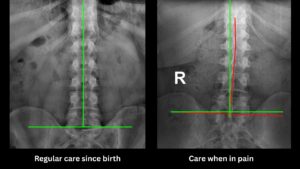
Years ago, I looked at three X-rays of young athletes who were all around the same age.
One of them was my son.
He was 15 years old at the time, playing competitive hockey, training hard, taking hits, shooting pucks, and putting his body through the same physical stress many Kelowna hockey families know very well. The other two athletes were also strong, active, talented young people. From the outside, all three looked healthy. They were fit. They were competitive. They could perform.
But their X-rays told three very different stories.
One young athlete had been checked and supported proactively. One had only received care when symptoms showed up. One had never had a spinal or nerve system checkup until problems became harder to ignore.
That moment stayed with me, not only as a chiropractor who has looked after hundreds of athletes, but as a dad.
Because when we look at young athletes from the outside, it is easy to assume everything is fine. They are fast, strong, flexible, and competitive. They may be scoring goals, making teams, winning medals, and playing at a high level. But posture, spinal alignment, and neurological function are not always obvious from the stands.
This is why prevention matters.
At 100+Living Health Centres in Kelowna, we look at young athletes through a bigger lens. We are not simply asking whether they hurt today. We are asking how their body is adapting, how their spine is developing, how their nervous system is functioning, and whether their sport is helping build a stronger future or quietly creating stress patterns that may affect them later.
For me, this is not just about chiropractic for young athletes. It is about performance optimisation for life.
Why Prevention Matters for Young Athletes
Many parents wait for pain before they take action. That is understandable. Pain is usually what gets our attention. If a child is not complaining, limping, or sitting out, it is easy to assume their body is handling the sport well.
The challenge is that pain is not always the best early warning sign.
Young athletes are incredibly adaptable. They can compensate for tightness, imbalance, poor posture, and spinal stress for months or even years. They may continue to skate, run, jump, shoot, tumble, or throw at a high level even while their body is developing patterns that may create problems later.
That is why I believe every serious young athlete deserves more than a pain-based approach.
At 100+Living Health Centres, we do not want to simply chase symptoms. We want to understand function. How is the spine moving? How is the posture developing? Is the pelvis balanced? Is the head shifting forward? Is one side of the body doing more work than the other? Is the nervous system getting clean, balanced input from the body?
These questions matter because your child’s spine and nervous system are not separate from their performance. They influence balance, movement, coordination, recovery, resilience, and long-term health.
This does not mean every young athlete has a serious problem. It simply means that waiting for pain may cause parents to miss important signs that the body is already under stress.
Why Hockey Can Be So Hard on a Young Spine
Here in Kelowna and throughout the Okanagan, hockey is part of the culture. Parents know the early mornings, cold rinks, tournaments, dryland training, skills sessions, power skating, and long weekends on the road. It is a great sport. It teaches discipline, teamwork, courage, and commitment.
It is also demanding on a young body.
Hockey players rotate, shoot, check, fall, stop, start, and absorb impact over and over again. Most players shoot from the same side thousands of times. Their hips, shoulders, ribs, spine, and pelvis repeat the same motion again and again. Over time, the body may adapt to that repeated pattern.
One side may become stronger. One side may become tighter. One hip may begin to work differently than the other. The shoulders may rotate differently. The head may shift forward. The spine may begin to compensate.
Parents may not see this at first. Their child may still be scoring goals, skating hard, and making the team. But performance does not always mean the structure is healthy.
A young athlete can look strong on the outside while their spine is already showing signs of stress on the inside.
That is the point I want parents to understand.
It Is Not Just Hockey
While hockey is a major sport in Kelowna, the same principle applies to many youth sports.
Soccer players often kick with the same leg again and again. Baseball and softball players throw and bat from the same side. Gymnasts repeat extreme positions that place heavy demands on the spine, wrists, shoulders, hips, and neck. Dancers repeat turnout, extension, and one-sided movements. Golfers and tennis players rotate the same direction thousands of times. Volleyball players jump, land, twist, and strike repeatedly.
The body adapts to what it does most.
That is one of the amazing things about the human body. It gets better at what we practise. But that also means repeated one-sided movement can train the body into imbalance if there is not enough correction, recovery, and awareness.
This is where a performance-focused chiropractic assessment can play an important role. Not because chiropractic replaces coaching, strength training, stretching, nutrition, sleep, or recovery. It does not. But a proper spinal and postural assessment can help parents understand whether their child’s body is adapting well or compensating in ways that may create future strain.
For families who want to understand this more deeply, our page on posture correction in Kelowna explains why posture is about more than appearance. It affects how the body moves, adapts, and responds to stress.
What Parents Should Watch For
Parents do not need to become experts in spinal biomechanics. But they can learn to notice simple changes.
Look at your child’s posture from the front, side, and back. Do the shoulders sit evenly? Does one hip look higher? Does the head sit forward? Does one shoulder blade stick out more than the other? Do they always lean to one side when standing? Does their jersey, backpack, or clothing sit unevenly?
Watch how they move. Do they rotate better one way than the other? Do they always complain of tightness on one side? Do they keep having the same small injury? Are they stretching constantly but never really improving? Do they seem stiff after games or practices? Are they losing mobility as their sport becomes more intense?
None of these signs automatically mean something serious is wrong.
But they are clues.
They are reasons to ask better questions. And for parents of young athletes, asking better questions early can make a big difference.
Symptom-Based Care Versus Performance-Focused Corrective Care
Many people think of chiropractic care only after pain begins. A child hurts their back, neck, hip, shoulder, or knee, and then the family looks for help. That type of care can be valuable, especially when an athlete is uncomfortable and needs support.
But corrective chiropractic care looks deeper.
Instead of only asking, “Where does it hurt?” we ask, “Why is this happening?” We look at posture, spinal alignment, movement patterns, neurological function, and the way the body is adapting to repeated stress.
This is where performance-focused corrective care becomes so important.
For young athletes, the goal is not simply to get them out of pain and back into the next game. The bigger goal is to help them build a stronger foundation for movement, recovery, coordination, and long-term health. That is the 100+Living approach. We are not just thinking about this season. We are thinking about the body your child will carry into adulthood.
At 100+Living Health Centres, our approach is based on objective findings whenever appropriate. That may include postural analysis, neurological testing, balance assessment, range of motion, functional movement checks, and digital X-rays when clinically indicated. We do not want to guess. We want to measure.
That is also why our work is built around Chiropractic BioPhysics®, or CBP®. CBP® is an evidence-informed structural rehabilitation system designed to assess and improve posture, spinal alignment, and function over time. It may include mirror image rehabilitation, mirror image adjusting, 3-D spinal traction, home exercises, Denneroll orthotics, progress imaging, and other corrective strategies based on the individual.
Families who want to learn more about our corrective approach can visit our page on Advanced Certified Chiropractic BioPhysics® care in Kelowna.
Every young athlete is different. A hockey player is different from a gymnast. A soccer player is different from a dancer. Even two hockey players on the same team can have very different spinal patterns.
That is why care should not be generic.
What a Corrective Chiropractic Assessment Looks Like for a Young Athlete
When a young athlete comes into 100+Living Health Centres, the goal is not to scare the family or tell them they need to stop playing the sport they love. The goal is to understand what is happening and help the family make informed choices.
A proper assessment may look at posture, spinal curves, head position, shoulder balance, pelvic alignment, flexibility, movement patterns, balance, and neurological function. If X-rays are clinically appropriate, they may help us understand the structure more clearly.
This matters because posture is more than appearance.
Posture influences how the body moves, how force travels through the spine, how the nervous system receives information, and how the body adapts to stress. At 100+Living Health Centres, we summarize this with a simple equation:
Posture = Neurology = Longevity.
For young athletes, this is not only about today’s game. It is about the body they are building for the next 10, 20, 40, or 60 years.
Can Chiropractic Care Support Athletic Performance?
Many parents ask whether chiropractic care can improve athletic performance.
The honest answer is that performance is multi-factorial. It depends on coaching, skill, strength, mobility, nutrition, sleep, mindset, recovery, and genetics. Chiropractic care does not replace any of those things.
But when posture, spinal movement, and neurological function are working better, the body may move more efficiently. A young athlete may feel more balanced, more aware of their body, and better able to recover from the demands of training and competition.
That is why I prefer to think about this as performance optimisation, not simply sports care.
Performance optimisation is not about pushing harder at all costs. It is about helping the body work better. It is about improving the foundation. It is about helping young athletes move well, recover well, adapt well, and stay connected to the joy of their sport.
For some athletes, the biggest benefit may be pain relief. For others, it may be better movement. For others, it may be identifying a structural issue before it becomes a bigger problem. Every case is different, and no provider can guarantee injury prevention or performance changes.
But as a parent, I would rather know what is happening than guess.
For athletes dealing with recurring discomfort, parents may also find our pages on back pain treatment in Kelowna and neck pain treatment in Kelowna helpful, especially when symptoms are starting to interfere with practice, games, or daily life.
Why “No Pain” Does Not Always Mean “No Problem”
One of the most common mistakes in youth sports is assuming that no pain means everything is fine.
As parents, we all do this. Life is busy. Between school, practices, games, meals, homework, and family life, it is easy to focus only on the obvious problems. If our child is not complaining, we keep going.
But many spinal and postural changes do not begin with pain. They begin with compensation.
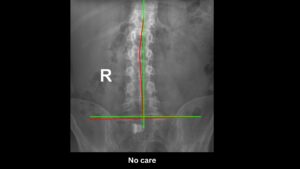
A child may shift weight to one side. They may rotate differently. They may lose normal spinal curves. They may develop forward head posture. They may build strength on top of poor alignment. Eventually, the body may start to complain, but by then the pattern may be more established.
This is why proactive chiropractic care in Kelowna is so important for young athletes. The goal is not to create fear. The goal is to give parents information.
When we understand what is happening, we can make better decisions.
The Bigger 100+Living Picture
At 100+Living Health Centres, our mission is not simply to help people feel better for a few weeks. Our mission is to help create the next Blue Zone on the planet right here in the Okanagan.
That may sound like a big goal, but it starts with simple choices made by families every day.
It starts with helping kids move well. It starts with protecting posture. It starts with supporting the nervous system. It starts with teaching young athletes that their body is not something to ignore until it breaks down. It is something to care for, train, restore, and respect.
Youth sport should build healthier adults.
It should build confidence, strength, resilience, friendships, and lifelong movement. It should not quietly train the body into patterns that create problems later.
That is why I believe young athletes deserve a bigger conversation around health, posture, performance, and longevity.
For families who want to understand the full scope of our work, the 100+Living Health Centres services page is a good place to start.
The Dad Angle
As a dad, I understand the dream.
I understand wanting your child to compete, improve, make the team, score the goal, win the tournament, and experience everything sport can teach them. I loved watching my kids play. I loved seeing their confidence grow. I loved watching them learn discipline, teamwork, and resilience.
But I also wanted them to enter adulthood strong, mobile, healthy, and capable.
That matters more than any single season.
The trophies, goals, medals, and memories are wonderful. But our kids only get one spine, one nervous system, and one body to carry them through life. If we can help them protect that body while they enjoy the sports they love, we should.
Youth sports should be a blessing, not something that quietly takes from their future health.
That is why I believe young athletes should be checked before pain becomes the reason we act.
Frequently Asked Questions
Should young athletes see a chiropractor?
Many young athletes may benefit from a chiropractic assessment, especially if they play repetitive, high-impact, or one-sided sports. The goal is not only to address pain, but to look at posture, spinal movement, balance, and how the body is adapting to training.
Can chiropractic care support athletic performance?
Chiropractic care may support athletic performance by helping improve spinal movement, posture, coordination, and nervous system function. It should be viewed as part of a bigger plan that includes coaching, strength training, nutrition, sleep, recovery, and smart training habits.
How often should a young athlete see a chiropractor?
It depends on the athlete, their sport, their posture, their injury history, and their assessment findings. Some young athletes may need short-term corrective care, while others may benefit from periodic checkups during the season. A proper recommendation should be based on objective findings, not guesswork.
What sports create the most spinal stress in young athletes?
Sports that involve repeated rotation, impact, falls, or one-sided movement can place more stress on the spine. Hockey, gymnastics, dance, soccer, baseball, lacrosse, golf, tennis, and volleyball are common examples.
What is the difference between symptom-based care and corrective chiropractic care?
Symptom-based care usually focuses on helping someone feel better after pain starts. Corrective chiropractic care looks at posture, spinal alignment, movement, and objective measurements to understand why the problem may be happening.
Can a chiropractor help prevent sports injuries?
No healthcare provider can guarantee injury prevention. However, proactive chiropractic care may help identify spinal and postural imbalances early, support better movement, and help young athletes build a stronger foundation for sport and life.
A Final Thought for Parents
Your child may look strong, fast, flexible, and healthy from the outside. But you cannot always see how their spine, posture, pelvis, and nervous system are adapting to the demands of sport.
That is why a proper assessment matters.
At 100+Living Health Centres in Kelowna, we help families look deeper. Our performance-focused corrective chiropractic approach is designed to assess posture, spinal structure, neurological function, and movement so parents can make informed decisions for their young athletes.
If your child plays hockey, soccer, gymnastics, dance, baseball, lacrosse, volleyball, golf, tennis, or another high-demand sport, we invite you to take a proactive step.
Schedule a 15-minute pre-consultation discovery call with 100+Living Health Centres to see whether our approach may be a fit for your young athlete.
Let’s help your young athlete move better, recover better, and build a stronger foundation for life.
Designed for Health. Engineered for Longevity.
Take the Next Step
Don’t settle for temporary relief. Get care that helps correct the cause of your condition.
Step 1:
Start with a free 10-minute phone consult to discuss your symptoms and see if our approach is right for you.
Step 2:
Book your first comprehensive exam and consultation and get started.








2 Comments. Leave new
Reading your article has greatly helped me, and I agree with you. But I still have some questions. Can you help me? I will pay attention to your answer. thank you.
For this kind of technology I would encourage you to reach out to your closest chiropractic biophysics (CBP) office, we’re in the Okanagan Valley in British Columbia. Here is the link to find the closest CBP doctor to you https://idealspine.com/directory/