Anterolisthesis Treatment Kelowna: How One Patient Avoided the Surgical Path and Regained Her Life
Jacqueline walked into our office frustrated, discouraged, and honestly, running out of belief that anything meaningful could still be done for her spine.
For nearly two years she had been under regular chiropractic care. She had been consistent. Faithful with her appointments. Committed to doing what she was told. And despite all of that effort, very little had changed.
That’s one of the hardest situations for patients emotionally because by the time they arrive at our office, they’ve often already convinced themselves they’ve “tried chiropractic.”
What they don’t realize is that not all chiropractic approaches are the same, especially when you’re dealing with advanced structural spinal conditions.
Jacqueline wasn’t dealing with a simple lower back strain.
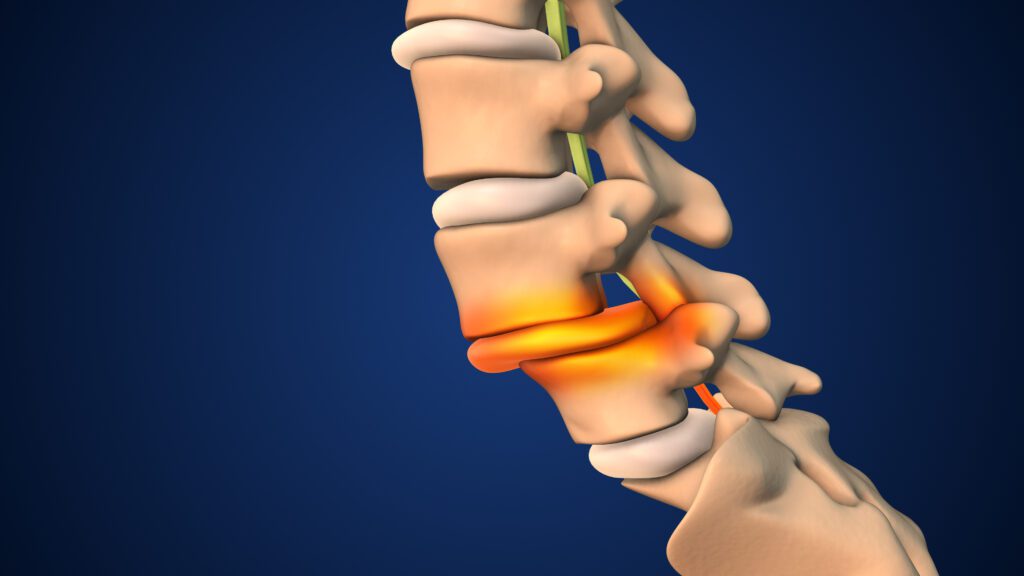
Her imaging showed a fairly advanced anterolisthesis at L4 over L5. In plain language, one vertebra and disc had shifted forward relative to the one below it. That slippage was creating significant instability in her lower spine and placing stress not only on the nerves exiting the spine, but also on the spinal cord and supporting ligament structures.
And unfortunately, conditions like this usually do not improve with generalized care alone.
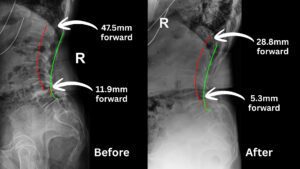
What made Jacqueline’s case even more concerning was that the problem wasn’t isolated to her lower back. Her rib cage had translated significantly forward, and she had a flattened cervical curve in her neck. This matters because spinal biomechanics is a whole-spine issue. You cannot effectively stabilize severe lumbar instability while ignoring what the rest of the spine is doing.
That’s one of the biggest misconceptions people have about spinal care.
The body does not work in disconnected pieces.
Everything compensates for everything else.
If the neck loses its curve, the mid-back adapts. If the rib cage shifts forward, the lower back changes how it bears load. Over time, those compensations create abnormal stress patterns through the entire spinal system.
This is why so many people bounce from provider to provider without lasting change.
They’re chasing symptoms instead of correcting structure.
Jacqueline’s history actually made this even more frustrating because she was the ideal patient in many ways. She had always taken care of herself. She exercised regularly. She stayed active. She was motivated and disciplined. She wanted to ski, cycle, hike, train, and fully enjoy retirement in Kelowna.
Instead, her spine was slowly taking those things away from her.
And the really dangerous part about anterolisthesis is that it tends to progress gradually.
At first it may simply feel like stiffness or recurring lower back pain. Then people begin noticing weakness in the legs, numbness, reduced endurance, or instability. More advanced cases can begin affecting bowel and bladder function because of the neurological compromise involved.
That’s why this condition deserves proper attention early.
What Is Anterolisthesis?
Anterolisthesis means one vertebra has slipped forward relative to the vertebra below it. You may also hear it described as “slippage of vertebrae in the lower back.”
The condition is closely related to spondylolisthesis, although technically anterolisthesis refers specifically to forward slippage.
The most common areas affected are:
- anterolisthesis L4 over L5
- anterolisthesis L5 on S1
These lower spinal regions absorb enormous amounts of stress during daily movement, especially in people who spend years sitting, lifting, bending, or dealing with repetitive spinal strain.
The degree of slippage is usually measured in millimetres or grading systems.
In Jacqueline’s case, the slippage was over 11 mm initially, which is significant.
After approximately four months of focused corrective care, we reduced that slippage to under 6 mm.
That’s a very meaningful structural change.
What Causes Anterolisthesis?
There isn’t usually one single cause.
Most cases develop over time because of a combination of:
- repetitive spinal stress
- poor posture
- disc degeneration
- ligament instability
- prolonged sitting
- previous injuries
- loss of spinal curves
- weakness in stabilizing muscles
Years at a desk can absolutely contribute to these patterns, especially when combined with poor spinal biomechanics.
In Jacqueline’s case, years of computer work managing a successful business likely contributed significantly to the structural stress her spine was under.
The spine adapts to the positions we place it in repeatedly.
And unfortunately, most people today spend enormous amounts of time in positions that slowly destabilize the spine.
What Are the Symptoms of Anterolisthesis?
Anterolisthesis symptoms can vary dramatically depending on severity and neurological involvement.
Some people only experience stiffness or recurring lower back pain.
Others develop:
- leg weakness
- sciatica
- numbness
- tingling
- instability
- difficulty standing or walking
- muscle fatigue
- reduced athletic performance
More advanced cases can begin affecting spinal cord function and nerve system control.
That’s why patients often feel like they’re “aging faster” physically than they should.
They lose confidence in movement.
They stop trusting their body.
And over time, they begin avoiding activities they once loved.
That’s exactly what was starting to happen with Jacqueline.
Is Anterolisthesis Serious?
It absolutely can be.
Not every case progresses aggressively, but instability in the spine is never something to casually ignore.
The problem with anterolisthesis is that the body often compensates for years before symptoms become severe.
People adapt slowly.
Until one day they realize:
- they can’t move the same
- they’ve lost strength
- their balance is changing
- their endurance is dropping
- pain is becoming more constant
This is why proper structural imaging matters so much.
You cannot accurately understand spinal instability from symptoms alone.
How CBP Treats Anterolisthesis
This is where Advanced Certified Chiropractic BioPhysics changes the conversation.
Traditional chiropractic often focuses primarily on mobility and temporary symptom relief.
CBP focuses on structural correction.
That distinction matters enormously in cases like Jacqueline’s.
When she came into our office, we completely changed the strategy.
First, we transitioned her away from generalized home exercises and introduced very specific mirror image exercises designed to reverse her distortion pattern.
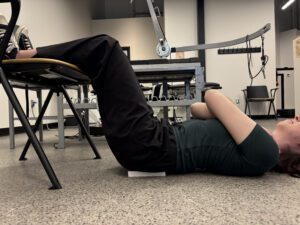
Second, we changed the way she was being adjusted.
Some of the traditional adjustments she had been receiving were actually reinforcing the instability pattern instead of correcting it.
That’s an uncomfortable reality in healthcare, but it’s important for patients to understand: the wrong force in the wrong direction can absolutely worsen instability in complex spinal cases.
So we transitioned her into mirror image adjusting.
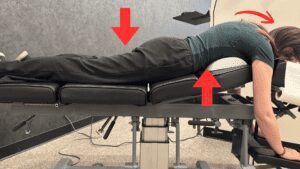
Mirror image adjusting is designed to place the body into the exact opposite position of the structural distortion pattern.
This is one of the foundational concepts of Chiropractic BioPhysics.
Third — and perhaps most importantly — we introduced RoboTrac traction.
This became the game changer in her case.
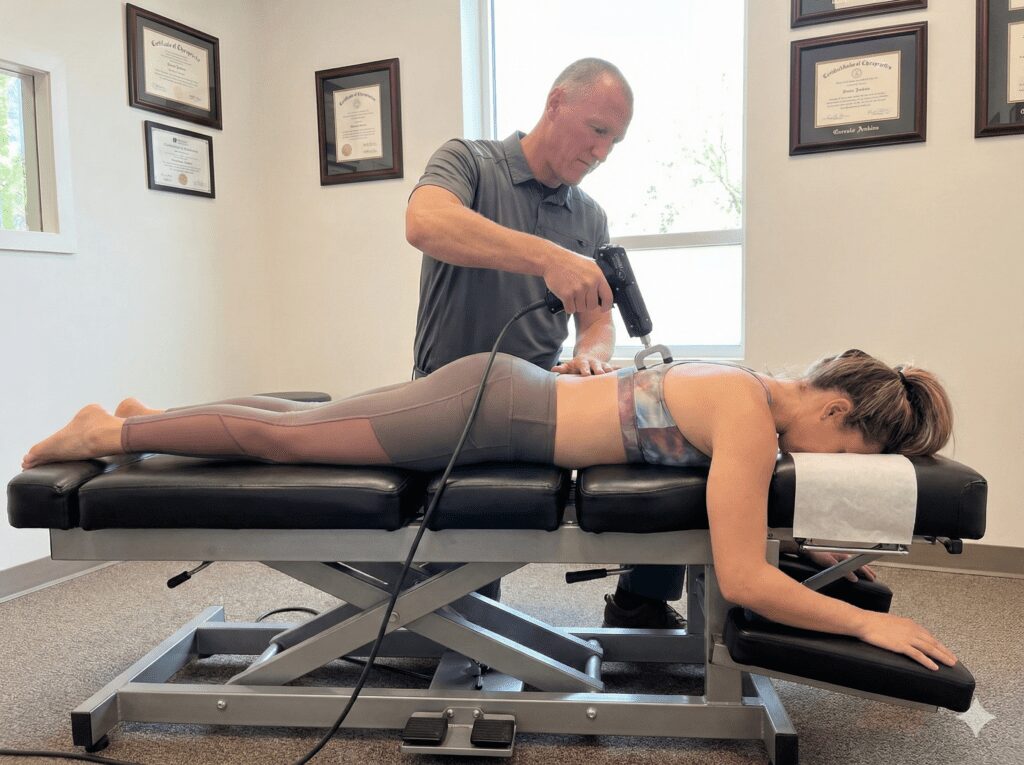
This is the RoboTrac system we used as part of Jacqueline’s structural correction program to reduce spinal instability and improve alignment.
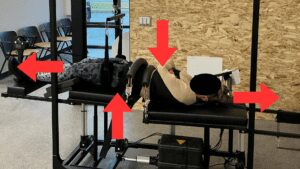
Jacqueline completed RoboTrac traction twice per week for 16 weeks as part of her corrective care program.
Learn more about our 3D spinal traction protocols.
The RoboTrac table is emerging as one of the most promising conservative approaches for reducing anterolisthesis and retrolisthesis.
Research by Curtis A Fedorchuk and others has validated the role of targeted spinal traction in stabilizing damaged ligament structures and improving spinal positioning.
Currently, there are only three RoboTrac systems in Canada, and ours has been modified specifically to address not only lower back instability but cervical and thoracic structural correction as well.
That’s one of the advantages of being an Advanced Certified CBP office.
You’re constantly refining systems and adapting technology to improve outcomes.
And as I mentioned a few sentences Jacqueline was only on the RoboTrac table twice per week for approximately 16 weeks. Meanwhile these conditions take years to develop. . . it really is incredible what the human body can accomplish when we apply an intelligent, evidence based approach.
The result?
Her slippage reduced dramatically.
More importantly, her function improved dramatically.
What to Avoid With Anterolisthesis
This is another area where people unintentionally make their condition worse.
Not all exercises are beneficial for spinal instability.
In fact, some common exercises may increase stress on damaged structures.
Movements involving excessive lumbar extension, uncontrolled twisting, heavy axial loading, or poorly designed stretching routines can aggravate instability patterns.
This is why random YouTube exercises are often a terrible strategy for people with spinal degeneration.
You need exercises matched to your actual biomechanics.
That’s also why surgery should not automatically be viewed as the only option.
Some patients absolutely require surgery.
But many do not.
Especially if structural correction and stabilization strategies are implemented properly before the condition becomes too advanced.
If you want to learn more about related care approaches, you can also explore:
- disc injury treatment
- chiropractic for lower back pain
- anterolisthesis L4 L5 exercises
- 3D spinal traction
What Makes Structural Correction Different?
One of the biggest differences at 100+Living Health Centers is that we are not simply chasing pain relief.
Pain is important, of course.
But pain is often the last thing to show up and the first thing to disappear.
Structure matters more.
Because structure determines how the spine handles force over time.
When spinal biomechanics improve:
- load distribution improves
- nerve system stress decreases
- stability improves
- movement confidence improves
- long-term degeneration may slow significantly
This is why Jacqueline now feels optimistic again about her future.
She’s returning to strengthening work she had previously avoided.
She’s moving more confidently.
And perhaps most importantly, she no longer feels trapped in the belief that surgery is inevitable.
Can Anterolisthesis Be Fixed Without Surgery?
In some cases, yes.
Not every case.
Not every patient.
But many people are far more capable of improvement than they’ve been led to believe.
Especially when the care strategy is specific, measurable, and structurally focused.
Jacqueline’s case is proof of that.
Her spine changed.
Her function changed.
And her outlook changed.
That’s what happens when the right strategy finally matches the problem.
If You’ve Lost Hope, Read This Carefully
If you’ve been under care before and didn’t improve. . .
If you’ve tried multiple providers. . .
If you’ve been told surgery is your only option. . .
Please understand: there may still be another path.
At 100+Living Health Centres, we focus on advanced structural correction strategies designed to restore spinal biomechanics and improve neurological function.
We exist for people who feel like they’ve run out of options.
If this story resonates with you, book a free 10-minute phone consultation with Dr. Jenkins in Kelowna today.
You do not have to give up on your spine.
And you do not have to assume your future has already been decided.
Take the Next Step
Don’t settle for temporary relief. Get care that helps correct the cause of your condition.
Step 1:
Start with a free 10-minute phone consult to discuss your symptoms and see if our approach is right for you.
Step 2:
Book your first comprehensive exam and consultation and get started.