
When the World Doesn’t Fit You: Why Your Unique Anatomy Hurts in a Standardized World
By Dr. Graham Jenkins, 100+ Living
Have you ever walked into a room and felt like you just didn’t fit? Maybe the chair was too low, the counter was too high, or the car seat just wouldn’t go back far enough.
We tend to think of these moments as minor annoyances. But in my 30 years of practice, I have seen these “annoyances” turn into chronic pain and long-term health issues.
Here is the truth: We live in a standardized world. Office desks are built for the “average” height. Cars are designed for the “average” driver. Tools are made for the “average” hand.
But human beings are not average. We are unique.
As teenagers, we obsess over our anatomy. We wish we were taller, shorter, or had a different nose or eye color. We focus on how we look. But as we grow into adults, the issue isn’t about vanity—it is about function.
When your unique anatomy clashes with a “one-size-fits-all” world, your spine pays the price. Whether you are 6’3″, 5’1″, or carrying extra weight on your chest, your body is constantly fighting gravity and poor ergonomics.
Today, I want to have a real, honest conversation about how your specific body type handles the modern world. We are going to look at why you might be hurting, and more importantly, how you can take control and fix it without surgery or drugs.
The Digital Trap: It’s Not Just for Office Workers Anymore
Before we dive into body types, we have to look at the environment we all live in.
Ten years ago, we could divide the world into “desk jobs” and “active jobs.” That line is gone.
I treat tradesmen—big, strong guys—who never thought they would spend their days staring at a screen. But today? They are on iPads in their trucks creating invoices. They are looking at digital blueprints on phones. They are hunched over laptops doing quotes for hours.
We have created a knowledge-based culture. To be successful today, whether you are a lawyer or a landscaper, you have to be plugged in. We rely on artificial intelligence and digital data more than ever. This digitization isn’t going away. It is only going to get more intense [1].
This means everyone is subjected to the same “tech neck” stress, regardless of how strong they are or what their job title is. And when you add unique anatomical challenges to this digital mix, you have a recipe for spinal disaster.
The Challenge of the “Tall Poppy”: The 6’3″ Reality
Let’s talk about my tall patients first.
Imagine you are 6’3″. You walk into an office where the desk is standard height (about 29 inches). The monitor stands are standard. The chair maxes out at a certain height.
The world is built for someone who is roughly 5’8″ to 5’10”.
So, what do you do? You don’t even notice it, but you adapt. You spread your legs wider to lower your torso. You round your shoulders. You hinge forward at the waist. And most dangerously, you drop your head forward to see the screen that is sitting too low.
This creates a massive amount of leverage on the spine. Your head weighs about 10-12 pounds. For every inch it moves forward, the weight on your neck doubles. For a tall person forcing themselves into a small workspace, that head carriage can cause up to 60 pounds of pressure on the neck muscles and the delicate nerves of the upper spine [2].
The Result:
-
Chronic upper back knots.
-
Tension headaches.
-
A “hunchback” appearance (Hyperkyphosis) developing in your 30s or 40s.
This isn’t just about looking slumped over. This tension compresses your lungs and heart, affecting your energy and your long-term health.
The Petite Struggle: Living in a Big World
Now, let’s flip the script. I see many patients who are 5’0″ or 5’2″. They are living in that same 5’10” world, but their problem is different.
When they sit in a standard chair, their feet often dangle or barely touch the floor. This creates instability in the hips and lower back. Because the desk is relatively high for them, they have to shrug their shoulders up toward their ears just to type on the keyboard.
They spend 8 to 10 hours a day in a state of constant muscle contraction. Their Trapezius muscles (the big muscles on top of the shoulders) act like earrings because they are pulled up so high.
The Result:
-
Numbness and tingling in the hands (often mistaken for Carpal Tunnel).
-
Severe neck stiffness.
-
Lower back pain from lack of foot support.
For these patients, the “norm” is literally a pain in the neck.
The Weight of Gravity: Anatomy and Curves
This is a sensitive topic, but one we need to address with respect and medical honesty because it affects so many women.
I see many female patients who have larger breasts. While society might focus on the visual aspect, as a doctor, I see the physics.
Extra weight on the front of the chest creates a constant downward pull. It acts like a fulcrum, pulling the upper back forward and rounding the shoulders. To compensate, the muscles between the shoulder blades have to work overtime, 24/7, just to keep the spine upright.
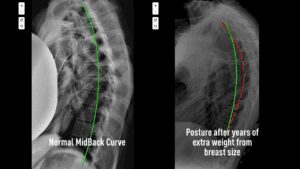
It is exhausting.
Many women deal with burning pain between the shoulder blades from their early teens. By the time they are adults, they are frustrated. I have seen breast reduction surgeries reach an all-time high because women are desperate for relief [3].
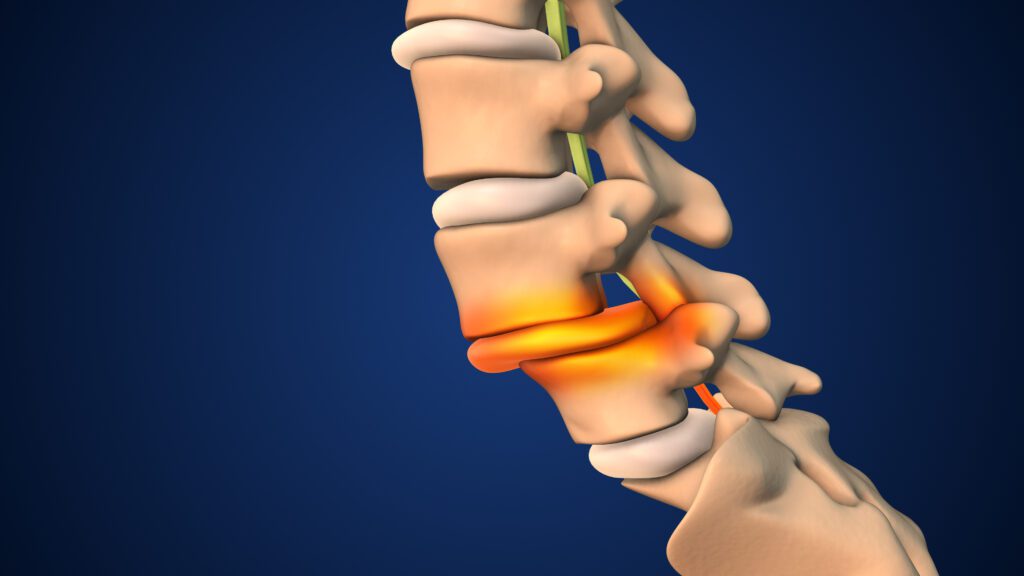
While surgery is a personal choice, it is often treated as the only solution. But often, the pain persists even after surgery because the structure of the spine has already changed. The curve has buckled. Removing the weight doesn’t automatically fix the 20 years of spinal shifting that occurred beforehand.
The “Big Guy” Paradox: Trades and Contortions
Let’s go back to those tradesmen I mentioned.
I see mechanics, plumbers, and electricians who are big, burly guys. They have incredible strength. But their anatomy works against them in tight spaces.
Imagine a guy with broad shoulders trying to squeeze under a kitchen sink to fix a pipe. Or a large mechanic bending over a small engine bay. They have to contort their bodies into pretzels.
They twist, side-bend, and hold these positions while applying force to a wrench.
Their size—which is an asset for lifting—becomes a liability for fitting. This leads to repetitive strain injuries. They might feel “tough” enough to push through the pain in their 20s, but by their 40s, those micro-traumas have built up into major spinal misalignments.
The “Rebuild Yourself” Mindset
So, what do we do? We can’t change our height. We can’t easily change our bone structure. And most of us can’t quit our jobs or stop using computers.
This is where we have to shift our mindset.
I was reading some thoughts inspired by Dr. Joe Dispenza recently that really struck a chord with me. The core idea was about breaking the habit of being yourself.
It is easy to fall into the trap of saying, “Well, I’m just tall, so I’ll always have a bad back,” or “My job requires this, so I just have to live with the pain.”
That is the “Old Self” talking. That is the victim mindset. It is waiting for the world to change for you. It is waiting for a “magic pill” or a surgery to fix you.
But as Dispenza says, true transformation requires us to stop waiting for someone to save us. The person you are becoming is entirely your responsibility.
If the world isn’t built for your anatomy, you have to build a body that is strong enough to handle the world. You have to take proactive steps to support your structure.
The Solution: Structural Support for Unique Bodies
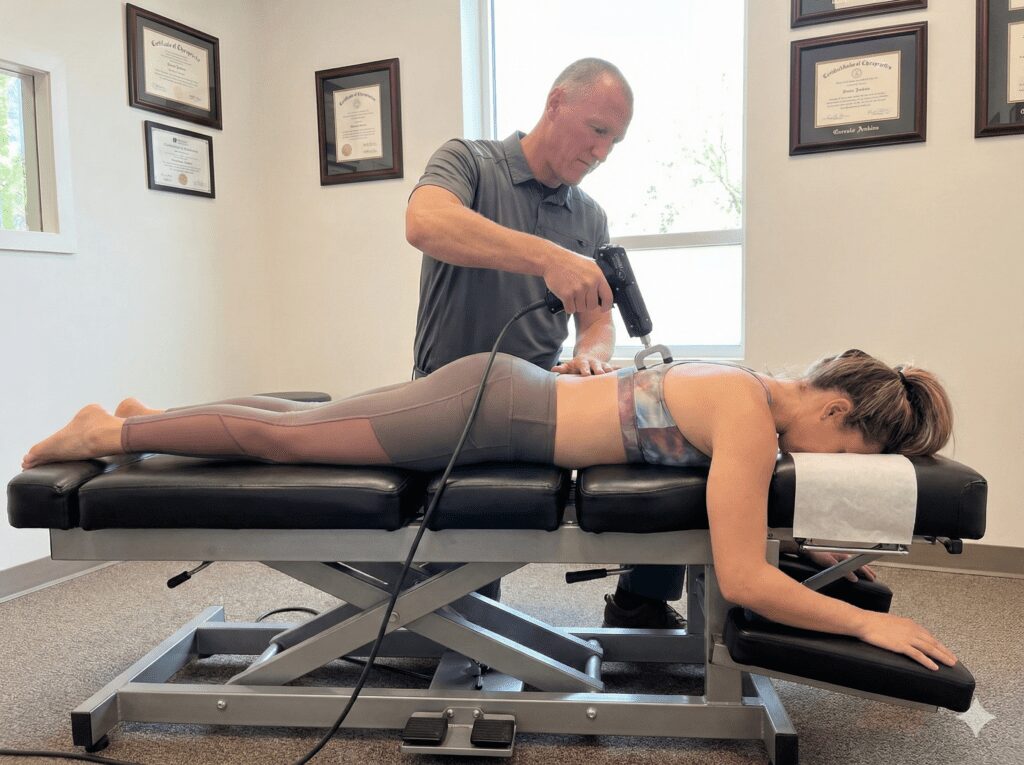
In my clinic, we use a method called Chiropractic BioPhysics (CBP). Unlike traditional chiropractic, which might just “crack” a joint for temporary relief, CBP is about structural engineering.
We look at your X-rays like a blueprint.
If you are the tall guy with the forward head, we don’t just massage the neck. We use specific traction and mirror-image exercises to pull that head back over the shoulders. We restore the curve so your muscles can relax.
If you are the woman with the heavy chest, we work on strengthening the posterior chain (the back muscles) and correcting the thoracic curve (kyphosis) so your spine acts like a strong column that can support the weight effortlessly, rather than a bending willow branch that is about to snap.

3 Steps to Reclaim Your Comfort
Here is your action plan. This is how you start living the 100+ Living way—proactive, hopeful, and in control.
1. Audit Your Environment (The Ergonomic Check)
You might not be able to change your height, but you can change your chair.
-
For the Tall: Elevate your monitor. Put it on a stack of books if you have to. The top third of the screen should be at eye level. Get a desk riser.
-
For the Petite: Get a footrest. Immediately. If your feet are solid, your back is solid. And bring that keyboard down so your elbows are at 90 degrees.
-
For the Tradesman: When you are doing paperwork, don’t do it on the center console of your truck twisted to the side. Take 5 minutes to sit square, or stand up and put the iPad on the hood of the truck at chest height.
2. Move With Intention (The Mobility Check)
If you are locked in a specific posture all day, you need to do the opposite.
-
The “Brugger’s Relief” Position: Every 30 minutes, sit at the edge of your chair, spread your legs, turn your palms out, extend your fingers, and pull your chin back (give yourself a double chin). Hold for 30 seconds. This reverses the “tech slump.”
3. Seek Structural Correction (The Reality Check)
Ergonomics and stretching are great, but they are maintenance. If your spine has already shifted due to years of fitting into a world not made for you, you need correction.
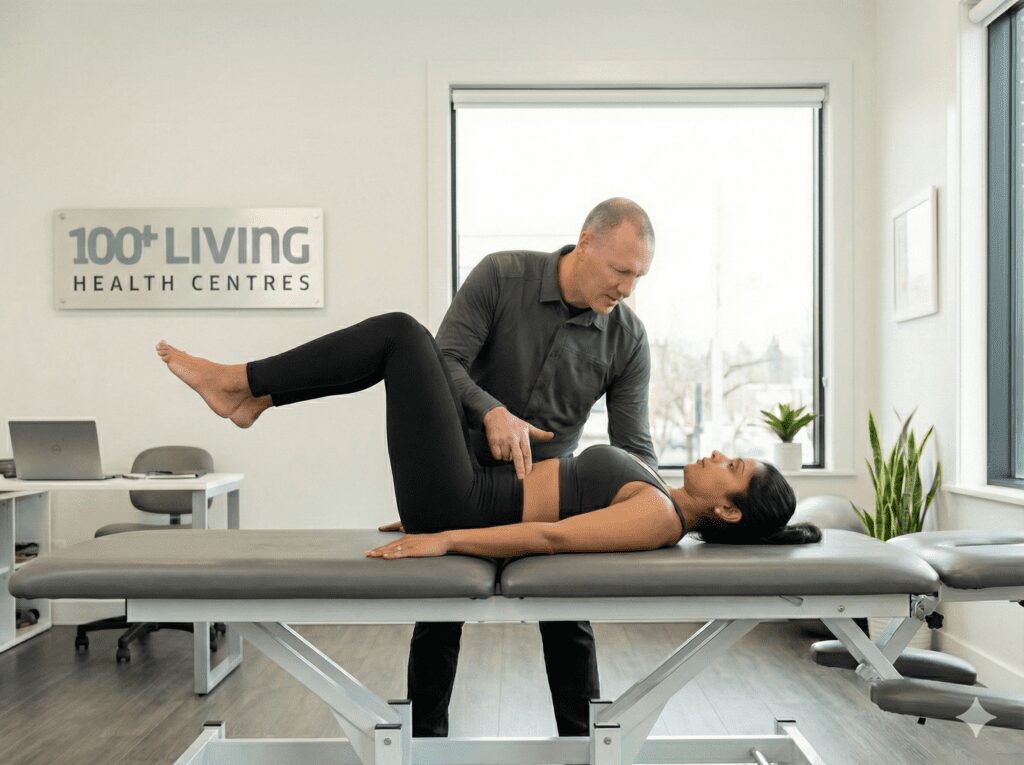
This is where CBP comes in. We measure your deviation from normal to the millimeter and degree. We help you remodel the spine back to its strongest position [4].
Conclusion: Your Anatomy is Not a Curse
I want to leave you with this thought: Your height, your curves, and your build are part of who you are. They are not mistakes.
The pain you are feeling isn’t a sign that your body is “bad.” It is a signal. It is a “Check Engine” light telling you that your unique machinery needs some specific support.
You don’t have to suffer just because you are 6’3″ or 5’1″. You don’t have to accept upper back burning as a “normal” part of womanhood. And you certainly don’t have to let your job destroy your mobility.
We can’t change the standardized world overnight. But we can build a resilient, aligned spine that allows you to live comfortably within it.
You were built to thrive, not just survive the workday.
If you are tired of trying to fit a square peg into a round hole and hurting because of it, let’s take a look at your blueprint. Let’s get your structure right. Because when you stand tall—at whatever height you are—you are setting yourself up for a long, active, and happy life.
Live Past 100—On Purpose.
References
[1] Straker, L. M., & Mathiassen, S. E. (2009). Increased physical inactivity with the digitization of work: the need for a new research paradigm. Ergonomics, 52(2), 265-270.
[2] Hansraj, K. K. (2014). Assessment of stresses in the cervical spine caused by posture and position of the head. Surgical Technology International, 25, 277-279.
[3] American Society of Plastic Surgeons. (2020). Plastic Surgery Statistics Report. ASPS National Clearinghouse of Plastic Surgery Procedural Statistics.
[4] Harrison, D. E., & Harrison, D. D. (2002). Chiropractic Biophysics technique: a linear algebra approach to posture in chiropractic. Journal of Manipulative and Physiological Therapeutics, 25(8), 2002.
[5] Oakley, P. A., et al. (2020). Restoring the cervical curve: A systematic review of randomized controlled trials. Journal of Physical Therapy Science, 32(10), 698-704.
Ready to Stop Fighting Your Own Body?
If you are exhausted by your anatomy or just tired of the daily struggle to get comfortable, you don’t have to handle it alone. We are here to help you rebuild. If you want to find out more about how structural correction can help you fit better in this world, click the link below. Someone from our 100+ Living team will reach out to listen to your story and help you find a path forward. Let’s get you moving freely again.
Take the Next Step
Don’t settle for temporary relief. Get care that helps correct the cause of your condition.
Step 1:
Start with a free 10-minute phone consult to discuss your symptoms and see if our approach is right for you.
Step 2:
Book your first comprehensive exam and consultation and get started.






)