June is International Scoliosis Awareness Month, an opportunity to increase understanding about one of the most misunderstood spinal conditions affecting children, teenagers, and adults.
For many families, a scoliosis diagnosis creates more questions than answers.
Will it get worse?
Will my child eventually need surgery?
Can anything be done to stop it from progressing?
Is pain inevitable?
Unfortunately, many families are still hearing the same advice they heard twenty years ago.
“Let’s just watch it.”
“Come back in six months.”
“We’ll monitor it.”
While monitoring certainly has its place, our understanding of scoliosis has evolved dramatically. Today, families have access to more information, better diagnostic tools, and more conservative treatment options than ever before.
At 100+Living Health Centres, our mission is to help create the next Blue Zone on the planet right here in the Okanagan. Part of that mission is helping people preserve their mobility, breathing capacity, neurological function, and quality of life throughout their lifetime.
Understanding scoliosis is an important part of that conversation.
Scoliosis Is More Than a Sideways Curve
One of the biggest misconceptions about scoliosis is that it is simply a sideways bend in the spine.
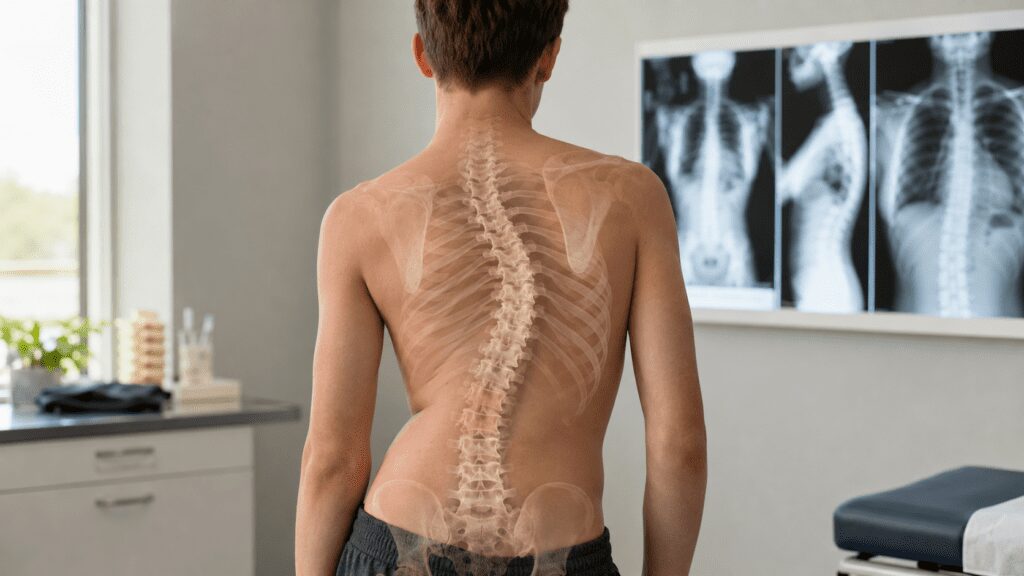
In reality, scoliosis is a three-dimensional spinal deformity.
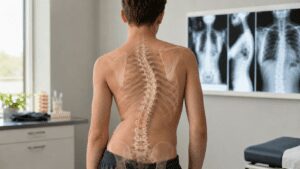
The spine bends sideways, rotates, and often creates changes throughout the rib cage, shoulders, pelvis, and overall posture. As the vertebrae rotate, the ribs frequently rotate with them, creating visible asymmetries that many parents first notice in their child.
This is why scoliosis is often associated with uneven shoulders, a rib hump, uneven hips, or clothing that never seems to hang quite right.
Scoliosis affects much more than appearance.
Depending on the severity and location of the curve, scoliosis can influence balance, movement, breathing mechanics, athletic performance, spinal health, and overall quality of life.
This is why modern scoliosis specialists no longer focus exclusively on the Cobb angle. While the Cobb angle remains an important measurement, it is only one part of a much larger story.
Why Pain Is a Poor Indicator
One of the most important things parents need to understand is that scoliosis often develops without pain.
Many teenagers with significant scoliosis have little or no discomfort.
Pain is often one of the last symptoms to appear and one of the first symptoms to disappear.
This means families cannot rely on pain as an early warning sign.
Instead, they should watch for postural changes such as:
• Uneven shoulders
• Uneven hips
• A rib prominence
• Leaning to one side
• Clothing fitting unevenly
• Changes in posture over time
The absence of pain should never be confused with the absence of a problem.
Early Detection Changes Everything
When scoliosis is identified early, families often have more options available to them.
One of the simplest screening tools available is Adam’s Forward Bend Test.
As a child bends forward, asymmetry of the rib cage or spine can become more obvious. This simple observation has helped identify scoliosis in countless children around the world.
Early detection does not guarantee a specific outcome.
However, it does provide an opportunity to understand the condition before significant progression occurs.
That opportunity matters.
Understanding the Three Levels of Scoliosis
At 100+Living Health Centres, we generally divide scoliosis into three broad categories.
Level One: 0-20 Degrees Cobb Angle
This is often where the greatest opportunity exists.
Our goal is to improve spinal balance, encourage structural correction where possible, and reduce the likelihood of future progression.
Early intervention can be incredibly valuable because the spine is often more adaptable and responsive during this stage.
Level Two: 20-40 Degrees Cobb Angle
At this stage, scoliosis requires more comprehensive management.
The focus shifts toward structural rehabilitation, spinal correction, progression prevention, and improving overall function.
Depending on age, growth potential, and progression risk, collaboration with scoliosis bracing experts may become appropriate.
Level Three: Greater Than 40 Degrees Cobb Angle
These cases require a broader discussion.
Conservative rehabilitation remains important and can often improve posture, balance, movement, breathing mechanics, and quality of life.
Bracing may still be appropriate in some situations, and surgical consultation may become part of the conversation.
Importantly, surgery should be viewed as part of the discussion—not necessarily the entire discussion.
Check out this link for a more comprehensive discussion of The 3 Levels of Scoliosis.
Why Scoliosis Requires a Three-Dimensional Solution
If scoliosis develops in three dimensions, it makes sense that rehabilitation should also occur in three dimensions.
This represents one of the most important shifts in scoliosis management over the past two decades.
Historically, many treatment approaches focused almost entirely on the side-to-side curvature.
Today, experts understand that successful scoliosis rehabilitation must address:
Side-to-side curvature.
Vertebral rotation.
Front-to-back spinal alignment.
Ignoring any one of these dimensions often limits the potential for meaningful improvement.
What Makes Modern Scoliosis Care Different?
One of the most exciting developments in scoliosis management has been the move toward objective measurement and individualized rehabilitation.
Every scoliosis is unique.
Two people can have the same Cobb angle yet require completely different treatment strategies.
This is why comprehensive assessments, posture analysis, movement evaluation, and weight-bearing X-rays play such an important role in modern scoliosis care.
At 100+Living Health Centres, our rehabilitation approach focuses on identifying the unique structural distortions present in each individual and developing a customized strategy designed specifically for them.
The Role of Advanced Certified Chiropractic BioPhysics®
One of the reasons I pursued Advanced Certification in Chiropractic BioPhysics® was because of its focus on objective measurements and structural correction.
Rather than guessing, we measure.
Rather than applying the same approach to every patient, we customize care based on the individual’s structural findings.
Using principles of biomechanics, spinal engineering, posture analysis, mirror image rehabilitation, corrective exercises, and three-dimensional traction, we work toward improving spinal alignment and function in a measurable way.
Today, 100+Living Health Centres is the only Advanced Certified CBP office in the Interior of British Columbia and one of only two Advanced Certified CBP offices in Western Canada.
Sarah’s Story
Sarah first came to our office frustrated and uncertain about the future.
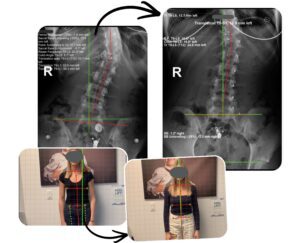
Like many people diagnosed with scoliosis, she had been told to monitor her condition and hope it didn’t progress.
What worried her most wasn’t how her scoliosis looked.
It was what might happen next.
Would it continue worsening?
Would surgery eventually become necessary?
Would she lose function as she aged?
Following a comprehensive assessment, Sarah began a customized rehabilitation program designed around her specific spinal distortion pattern.
Over time, she experienced measurable improvements in posture, balance, and overall function.
Most importantly, she regained confidence and a sense of control over her future.
There Has Never Been More Hope
One of the most damaging myths surrounding scoliosis is the belief that nothing can be done.
That simply isn’t true.
Not every scoliosis can be completely corrected.
Not every curve can be eliminated.
But today’s conservative treatment options provide more opportunities than ever before to positively influence outcomes.
For many patients, improvements in posture, function, breathing, confidence, and quality of life are realistic goals.
The key is understanding the condition early and building a strategy that is specific to the individual.
Join Us for Our Free Scoliosis Awareness Workshop
As part of International Scoliosis Awareness Month, we are hosting a complimentary community workshop on June 23rd to help families better understand scoliosis and the options available today.
During this workshop you will learn:
• What scoliosis really is
• Why scoliosis is a three-dimensional condition
• The three levels of scoliosis management
• Modern conservative treatment approaches
• The role of mirror image rehabilitation and three-dimensional traction
• When bracing should be considered
• Real patient case studies and outcomes
• How advanced technologies such as the UTS and Robotrac are being used in rehabilitation
You will also have the opportunity to ask questions and experience some of the technology used in modern scoliosis rehabilitation.
Reserve your seat today:
Register through EventBrite Here
Knowledge creates options.
The earlier families understand scoliosis, the greater their opportunity to make informed decisions about the future.