One of the first questions many families ask after a scoliosis diagnosis is simple.
Can this be corrected without surgery?
t is an understandable question. For many parents, the word scoliosis immediately brings up fear, uncertainty, bracing, surgery, and the feeling that their child’s future has suddenly become more complicated. For adults, especially those over 50, 60, or 70, a scoliosis diagnosis can raise a different set of concerns.
They may wonder whether their pain, stiffness, posture changes, balance issues, or declining function are something they will simply have to live with.
The good news is that scoliosis care has changed dramatically.
There are still cases where surgery is necessary. There are still cases where bracing plays an important role. And there are still cases where the goal may be stabilization rather than full correction.
But the old idea that families have only two choices — watch it or operate — is outdated.
In 2026, modern conservative scoliosis treatment offers more options than many families realize.
At 100+Living Health Centres in Kelowna, our goal is to help people understand what is possible today. We do not believe every scoliosis can be completely corrected. That would not be honest. But we also do not believe families should be told nothing can be done before a proper structural assessment has been completed.
There is a very big difference between “nothing can be done” and “nothing has been done yet.”
If you would like a broader overview of scoliosis and hyperkyphosis care at our clinic, you can read more on our scoliosis and hyperkyphosis treatment page.
What Does Scoliosis Correction Without Surgery Actually Mean?
When people ask if scoliosis can be corrected without surgery, they may be asking several different questions at once.
Can the Cobb angle be reduced?
Can posture improve?
Can pain decrease?
Can breathing become easier?
Can progression be slowed or stabilized?
Can surgery be avoided?
Can function improve?
These are all important questions, but they are not exactly the same question.
For some patients, correction may mean a measurable reduction in the curve on X-ray. For others, especially children and teenagers who are still growing, the most important goal may be preventing progression during growth. For adults, correction may mean improving posture, reducing mechanical stress, breathing better, moving more confidently, and preserving quality of life.
This is why every scoliosis case needs to be evaluated individually.
A ten-year-old child with a flexible 18-degree curve and significant growth remaining is very different from a 61-year-old adult with a long-standing thoracic scoliosis. A teenager with a rapidly progressing curve needs a different conversation than an adult with degenerative scoliosis, postural fatigue, and chronic pain.
The word correction should not be used casually.
It should be tied to clear measurements, clear goals, and a clear understanding of what is realistic for that person.
At 100+Living Health Centres, we are not simply trying to make someone feel better for a few days. We are looking at the structure of the spine, the flexibility of the curve, the patient’s stage of life, their function, their goals, and their potential for change.
That is the only way to have an honest conversation about scoliosis treatment without surgery.
Scoliosis Is Not Just a Sideways Curve
To understand whether scoliosis can be corrected without surgery, we first need to understand what scoliosis really is.
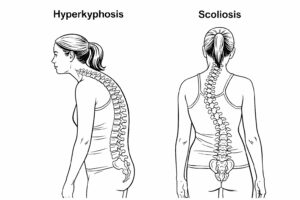
Scoliosis is not simply a sideways curve in the spine.
It is a three-dimensional spinal deformity.
The spine bends sideways, rotates, and often changes the position of the ribs, pelvis, shoulders, and overall posture. This is why scoliosis may create a rib hump, uneven shoulders, uneven hips, or clothing that seems to hang differently from one side to the other.
The rotational component matters.
When the spine rotates, the rib cage can rotate with it. This can change how the body balances, how the muscles work, how the joints load, and in more advanced cases, how the rib cage moves during breathing.
This is one of the reasons scoliosis needs to be assessed and managed differently than ordinary back pain.
A simple stretch or general strengthening program may help someone feel better, but scoliosis is a structural problem. Structural problems require structural thinking.
For a deeper explanation of why scoliosis is more than a sideways curve, including patient stories and references, you can also read our cornerstone scoliosis article.
Why X-Rays and Cobb Angles Matter in Scoliosis Treatment
Before anyone can determine what may be possible, the spine needs to be measured properly.
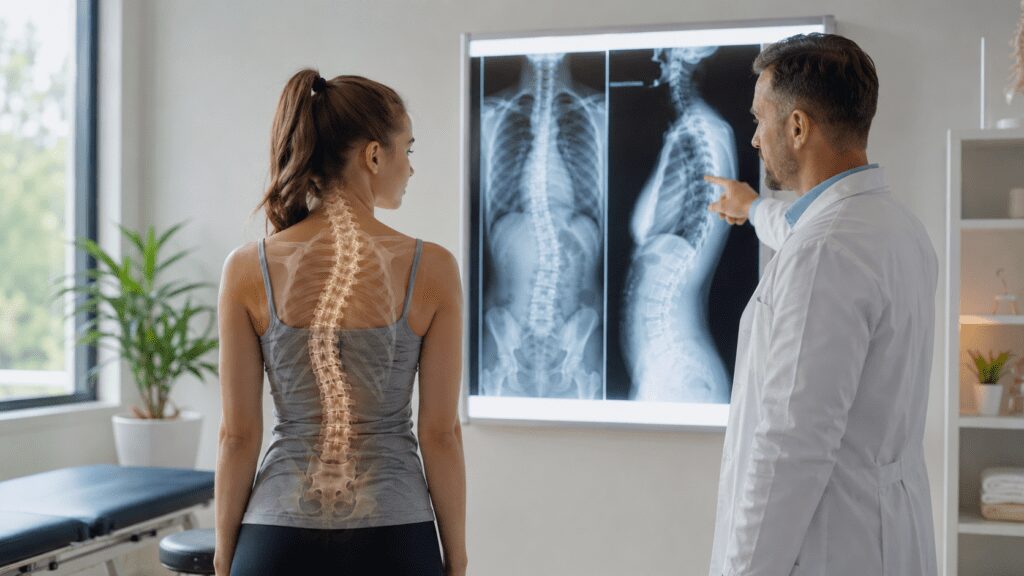
Standing X-rays are important because scoliosis is a structural condition that changes under the load of gravity. When someone is lying down, the curve may appear different than it does when they are standing, moving, and living their daily life.
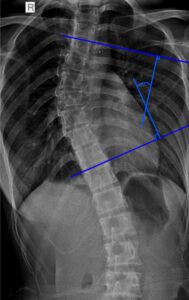
A proper scoliosis X-ray helps determine the Cobb angle, curve location, curve pattern, spinal balance, pelvic position, and other structural factors that influence treatment decisions.
It also allows the doctor to compare future X-rays and determine whether the curve is improving, worsening, or stabilizing.
This is critical.
Without objective measurements, everyone is guessing.
At 100+Living Health Centres, we can take standing scoliosis X-rays and accurately mark Cobb angles as part of a comprehensive structural assessment. This allows us to classify the curve, understand how advanced it is, track change over time, and design a conservative treatment plan based on the actual structure of the spine.
We are not simply asking, “Where does it hurt?”
We are asking, “What is the spine doing, how is it adapting, and what can we do to help move it toward better alignment, stability, and function?”
That is a very different conversation.
Why CBP Is Different From Standard Chiropractic for Scoliosis
This is an important distinction.
Many authoritative medical sources state that chiropractic care has not been shown to correct scoliosis curves. In many cases, they are referring to general chiropractic care or traditional spinal adjustments used primarily for pain relief or joint motion.
We agree that general chiropractic adjustments alone are not a complete scoliosis correction strategy.
Scoliosis is not simply a stuck joint or a sore back. It is a three-dimensional structural spinal condition.
That is why Advanced Certified Chiropractic BioPhysics®, or CBP®, is different.
CBP is focused on structural analysis, posture correction, spinal biomechanics, mirror image rehabilitation, corrective traction, and objective before-and-after measurement.
At 100+Living Health Centres, we are not simply adjusting the spine and hoping the scoliosis changes.
We measure the structure.
We analyse the X-rays.
We identify the distortion pattern.
We create a customized corrective strategy.
Then we re-measure to see whether the spine is changing.
That is what separates structural spinal rehabilitation from general symptom-based care.
You can learn more about our broader approach to structural spinal correction, mirror image care, and three-dimensional traction on our Advanced Chiropractic Services page.
Correction Potential X-Rays: How We Test Whether the Spine Can Move
One of the most unique parts of the CBP approach is something called a correction potential X-ray.
This is not something most people have ever heard of.
A correction potential X-ray allows us to test how flexible and responsive a scoliosis curve may be before committing to a full rehabilitation plan.
Here is how it works.
First, we take the patient’s original standing X-rays and analyse their spinal distortion pattern. We measure the Cobb angles, identify the apex of the curve, evaluate posture, and determine what type of traction setup may be required.
Then we roll the traction table into our X-ray room.
The patient is placed into their customized traction setup, with the corrective forces applied exactly where we believe they need to go. Once the patient is positioned in that corrective setup, we take another X-ray.
This gives us incredibly valuable information.
It helps us see whether the spine is flexible enough to respond to traction.
It helps confirm whether the corrective forces are moving the spine in the intended direction.
It gives us an early indication of how much correction potential may exist.
And it allows us to build a treatment plan based on objective findings rather than assumptions.
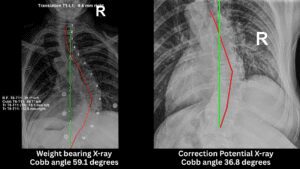
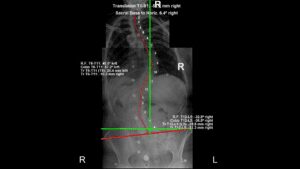
Recently, a 61-year-old patient began care in our office with a significant thoracic scoliosis measuring 59 degrees. During her correction potential X-ray, her thoracic curve reduced from 59 degrees to 38 degrees while positioned in her customized traction setup.
That does not mean every 59-degree curve will respond that way.
It also does not guarantee a final treatment outcome.
But it is an excellent indicator that the spine still has flexibility, mobility, and correction potential.
For a 61-year-old with a significant thoracic scoliosis, that kind of information is extremely valuable. It gives us a clearer sense of what may be possible and helps us design care with much more precision.
This is one of the reasons Advanced Certified CBP scoliosis care is fundamentally different from standard chiropractic care.
We do not guess.
We test.
Scoliosis 0–20 Degrees: What Is Possible Without Surgery?
Scoliosis in the 0–20 degree range is often where the greatest opportunity exists.
When scoliosis is identified early, the spine is often more flexible and more responsive to conservative care. The goals at this stage are correction where possible, stabilization, improved posture, better movement patterns, and reducing the likelihood of future progression.
For children and teenagers, this stage matters tremendously because growth can trigger progression.
A mild curve should never be ignored simply because it is mild.
All large curves were small curves at one point.
This is why early detection matters so much.
At this stage, conservative scoliosis treatment may focus on posture correction, mirror image exercises, mirror image rehabilitation, corrective traction when appropriate, home care strategies, and monitoring over time.
The goal is to help the spine move in a better direction before the curve becomes more advanced.
To learn more about our approach to mild scoliosis treatment in Kelowna, visit our 0–20 degree scoliosis care page.
Scoliosis 20–40 Degrees: Conservative Treatment and Stabilization
Scoliosis in the 20–40 degree range requires a more comprehensive strategy.
The goals are still correction and stabilization, but the level of commitment often needs to increase. These cases may require more intensive rehabilitation, more frequent monitoring, and a more detailed discussion about growth, progression risk, curve flexibility, and long-term function.
For growing children and teenagers, this is also the range where bracing may need to be considered depending on the specifics of the case.
When bracing is appropriate, we believe in collaborating with experienced scoliosis bracing professionals. This includes Dr. Brad Gage, an internationally respected scoliosis expert who has spent more than 20 years helping scoliosis patients and has worked with more than 1,000 bracing cases using a variety of brace options.
The goal is not to make one tool the entire solution.
The goal is to use the right tools, at the right time, for the right person.
For adults with a 20–40 degree scoliosis, the discussion may look different. Growth is no longer the issue, but degeneration, posture, balance, stiffness, pain, breathing mechanics, and quality of life often become much more important.
In these cases, conservative care may focus on improving spinal mechanics, reducing strain, supporting better posture, and helping the person function at a higher level.
To learn more about moderate scoliosis treatment in Kelowna, visit our 20–40 degree scoliosis care page.
Scoliosis 40+ Degrees: When Bracing or Surgery May Be Discussed
Once scoliosis progresses beyond 40 degrees, the conversation becomes more serious.
That does not mean conservative care has no value.
In many cases, conservative rehabilitation can still help improve posture, balance, movement, breathing mechanics, pain, and quality of life.
However, surgical consultation may become appropriate, especially when curves are severe, progressive, or affecting major life functions.
Our view is simple.
Surgery should not be feared when it is truly necessary.
But surgery should also not be assumed before a complete and thoughtful conservative assessment has been performed.
A 40-degree scoliosis in a growing teenager is very different from a 40-degree scoliosis in a stable adult. A flexible curve is very different from a rigid curve. A patient with strong function and good mobility is very different from a patient who is declining quickly.
This is why proper evaluation matters.
At 100+Living Health Centres, we want families to understand the full picture. That may include conservative rehabilitation, bracing consultation, surgical consultation, or a combination of professional opinions.
The key is making decisions based on objective information rather than fear.
To learn more about severe scoliosis treatment in Kelowna, visit our 40+ degree scoliosis care page.
Scoliosis in Adults Over 50, 60, and 70
One of the biggest gaps in scoliosis education is adult scoliosis.
Most scoliosis content is written for parents of teenagers. That is important, but it leaves many adults feeling overlooked.
In reality, many adults discover scoliosis later in life because of pain, stiffness, posture changes, loss of height, breathing changes, balance issues, or declining function.
Some adults have lived with adolescent scoliosis for decades.
Others develop degenerative scoliosis later in life as discs, joints, ligaments, and muscles change over time.
For adults over 50, 60, and 70, the goal of scoliosis treatment may be different than it is for a growing teenager.
The goals may include:
Improving posture.
Reducing pain.
Increasing mobility.
Improving balance.
Supporting better breathing mechanics.
Reducing mechanical stress on the spine.
Improving walking tolerance.
Helping maintain independence.
Improving quality of life.
And in some cases, achieving measurable structural improvement.
Adults should not assume they are too old to benefit from conservative scoliosis management.
The body remains adaptable throughout life.
It may not adapt as quickly as a child’s body, but it can still respond to the right inputs.
At 100+Living Health Centres, this fits directly into our mission to help create the next Blue Zone on the planet right here in the Okanagan. We want people to stay active, independent, mobile, strong, and engaged in life for as long as possible.
That includes adults with scoliosis.
You can learn more about our larger mission on our 100+Living Plan page.
Scoliosis Before and After: Why Objective Proof Matters
One of the biggest problems in scoliosis care is that many people are told what cannot be done before anyone has measured what is possible.
That is why before-and-after X-rays are so important.
They allow us to see whether the spine is changing.
They allow us to measure Cobb angles.
They allow us to evaluate posture, balance, alignment, and structural response.
They also help patients understand that their care is not based on guesswork.
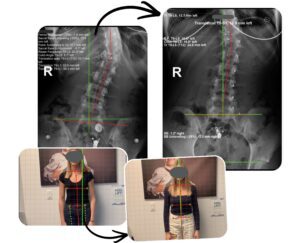
Sarah’s case is a good example.
When Sarah came to our office, she had spent years living with uncertainty around her scoliosis. She had been told to monitor it, but she wanted to know whether more could be done.
After a comprehensive assessment and customized corrective care plan, her before-and-after images showed measurable changes in posture, spinal alignment, and overall structural presentation.
The most important part was not simply the X-ray.
It was what the X-ray represented.
It showed that her spine could change.
It gave her confidence.
It gave her hope.
And it gave us objective information to guide her ongoing care.
The new 61-year-old patient’s correction potential X-ray also tells an important story. Her thoracic scoliosis measured 59 degrees on her original X-ray and reduced to 38 degrees while positioned in her customized traction setup.
Again, this does not guarantee a final correction outcome.
But it does show correction potential.
And that matters.
For patients and families who have been told nothing can be done, objective proof can completely change the conversation.
Can Surgery Always Be Avoided?
No.
It would be irresponsible to suggest that surgery can always be avoided.
There are scoliosis cases where surgical consultation is appropriate and necessary. Severe, progressive curves can create significant structural and functional challenges.
However, it is equally irresponsible to suggest that surgery is the only option for every scoliosis patient.
Many people fall into the space between observation and surgery.
These are the families who often feel forgotten.
They are told the curve is not bad enough for surgery but are not given a proactive plan to improve or stabilize it.
That is where modern conservative scoliosis treatment can make an enormous difference.
The goal is not to avoid surgery at all costs.
The goal is to make the best decision possible based on accurate information, proper measurements, the patient’s age, curve severity, curve flexibility, progression risk, symptoms, function, and goals.
What Is the Best Treatment for Scoliosis?
There is no single best treatment for every scoliosis case.
The best treatment for scoliosis depends on the person.
It depends on age, curve size, curve location, rotation, flexibility, symptoms, growth potential, posture, function, and goals.
For a growing child, the priority may be preventing progression through growth.
For an adult over 60, the priority may be improving posture, balance, mobility, pain, breathing mechanics, and quality of life.
For a severe scoliosis, the priority may be understanding all available options, including conservative rehabilitation, bracing consultation, and surgical opinion when appropriate.
At 100+Living Health Centres, our approach is to measure first, then build the plan.
We believe scoliosis care should be specific, objective, and customized.
The best treatment is not the one with the most impressive name.
The best treatment is the one that is right for the person standing in front of us.
The Earlier You Know, the More Options You Have
If there is one message every family should hear, it is this:
Do not wait for pain.
Do not wait for obvious deformity.
Do not wait until the curve becomes more advanced.
If you notice uneven shoulders, uneven hips, a rib hump, or changes in posture, it is worth having the spine assessed.
If your child has already been diagnosed with scoliosis and you have been told to simply watch it, it may be worth asking whether more can be done.
Monitoring is not the same as treatment.
Observation is not the same as intervention.
The earlier a family understands the curve, the more opportunity they often have to influence the future.
Join Us for Our Free Scoliosis Awareness Workshop in Kelowna
As part of International Scoliosis Awareness Month, 100+Living Health Centres is hosting a free community workshop on scoliosis care and management.
The workshop is happening June 23rd at 100+Living Health Centres in Kelowna.
During this workshop, we will discuss what scoliosis really is, why it is a three-dimensional spinal condition, how curves are classified from mild to advanced, and what modern conservative rehabilitation options are available today.
We will also demonstrate some of the advanced technology used in our clinic, including mirror image rehabilitation, three-dimensional traction, the UTS system, and Robotrac.
Most importantly, we want families to understand that scoliosis care has changed.
Click at the bottom of this blog post to see if there are more options available than you have been told.
Reserve your seat on Eventbrite here.
Or call or text our office at 250-875-2225.
Knowledge creates options.
And sometimes, asking one more question can change the direction of someone’s future.
Dr. Graham Jenkins, BSc, DC
Advanced Certified Chiropractic BioPhysics®
100+Living Health Centres
Kelowna, British Columbia
Helping create the next Blue Zone on the planet right here in the Okanagan.
Take the Next Step
Don’t settle for temporary relief. Get care that helps correct the cause of your condition.
Step 1:
Start with a free 10-minute phone consult to discuss your symptoms and see if our approach is right for you.
Step 2:
Book your first comprehensive exam and consultation and get started.
Frequently Asked Questions About Scoliosis Treatment Without Surgery
There is no single Cobb angle that automatically means surgery is required. However, surgical consultation is more commonly discussed when curves progress beyond 40 to 50 degrees, especially in growing adolescents or when the curve continues to worsen.
That does not mean every 40-degree scoliosis requires surgery.
Age, growth potential, curve flexibility, symptoms, progression rate, posture, breathing, and function all matter.
At 100+Living Health Centres, we believe decisions should be based on a complete structural assessment, not fear.
Many adults with scoliosis are able to manage their condition without surgery.
For adults, conservative care may focus on reducing pain, improving posture, increasing mobility, improving balance, supporting better breathing mechanics, and improving quality of life.
In some cases, measurable structural improvement may also be possible.
Surgery may still be appropriate in certain severe or progressive cases, but adults should not assume surgery is their only option without first receiving a proper scoliosis-specific assessment.
Yes.
General chiropractic care often focuses on joint motion, pain relief, and improving spinal mobility.
Advanced Certified Chiropractic BioPhysics® is different because it focuses on structural correction, posture analysis, X-ray measurements, mirror image rehabilitation, corrective traction, and objective before-and-after assessment.
At 100+Living Health Centres, scoliosis care is not based on random adjustments.
It is based on measuring the spine, understanding the distortion pattern, testing correction potential when appropriate, and building a customized rehabilitation strategy.
The most effective non-surgical treatment for scoliosis depends on the individual case.
In general, scoliosis care should be three-dimensional, customized, and based on objective measurements. It may include posture correction, mirror image rehabilitation, three-dimensional traction, home care strategies, bracing consultation when appropriate, and ongoing monitoring.
Because scoliosis is a three-dimensional structural condition, the most effective approach is rarely one single tool.
It is usually a customized strategy built around the patient’s curve, age, flexibility, symptoms, and goals.
A 40-degree scoliosis can often still benefit from conservative care, but the conversation becomes more serious.
For some patients, conservative treatment may help improve posture, pain, function, breathing mechanics, and quality of life. In some cases, stabilization or measurable structural improvement may be possible.
However, a 40-degree curve should be assessed carefully, especially in growing adolescents or if the curve is progressing.
Bracing consultation or surgical consultation may be appropriate depending on the case.
The length of non-surgical scoliosis treatment depends on the severity of the curve, the patient’s age, the flexibility of the spine, the goals of care, and how consistently the patient follows the plan.
Some patients may begin noticing functional changes within weeks, but structural scoliosis rehabilitation usually requires a longer-term commitment.
At 100+Living Health Centres, most corrective care plans are built around measurable phases of progress. We use follow-up assessments and X-rays when appropriate to determine how the spine is responding.